 Onwe Damian Chukwuemeka
It is frustrating to watch your high-quality content slowly fade from the first page of search results. You spent hours writing those posts, yet their traffic numbers continue to dip month after month.
The good news is that you don’t need to reinvent the wheel to fix this. In 2026, updating old blog posts is one of the smartest ways to boost your site performance because it builds on the authority you have already earned.
Instead of writing from scratch, you can spend a few hours refreshing existing pages to regain your rankings. This guide shows you how to revive stagnant content with minimal effort.
Finding Which Posts Need a Refresh
Data is your best tool for identifying which pages require attention. Instead of guessing, look at your search performance to find content that is already halfway to a top result. These pages are your “low-hanging fruit” because they have existing authority and relevance but just need a slight nudge to reach the first page.

Look for Stagnant, High-Potential Content
To find these pages, open your Search Console and sort your queries by position. Specifically, hunt for posts ranking between positions 11 and 25. These pages currently sit on the second or third page of search results, meaning Google already recognizes them as relevant but lacks the final confidence to rank them higher.
Pay close attention to these metrics when scanning your dashboard:
- Traffic decay: Filter for posts that once received consistent clicks but have seen a steady decline over the last six months.
- Impression spikes without clicks: If a post generates many impressions but few clicks, your title or meta description likely fails to attract the user, or your content is not answering the search intent well enough.
- Average position shifts: Look for pages that have slipped from the first page down to the second.
Focusing on these specific posts offers the quickest way to increase your blog visitors without writing new material. When a post already has some traction, updating it with modern examples or fixing structural gaps can often push it back into a top-three spot within weeks. You can also use digital monetization methods to ensure these high-potential pages are set up to capture value once the traffic returns.
Check for Outdated Information
Once you identify the right posts, perform a routine maintenance check to restore credibility. Search engines prioritize fresh, accurate data, so outdated details serve as a red flag that signals your content might be irrelevant.
Focus on these essential elements during your refresh:
- Replace old statistics: Swap out data from 2023 or 2024 with current 2026 figures. If you cannot find fresh data, explain why the trend remains consistent or clarify that the source material is historical.
- Update screenshots and visuals: Software interfaces and design trends change constantly. An outdated screenshot can instantly make a reader doubt the rest of your advice.
- Repair broken links: Use an internal tool or a simple crawler to find 404 errors. Redirect those broken links to current, helpful content on your site.
- Refresh dates and references: Ensure that any mention of “this year” or “current” refers to 2026. If a specific product or tool you recommended is no longer available, provide a modern alternative or remove the mention entirely.
Credibility is fragile, and users often bounce when they encounter an obvious error. By removing these friction points, you signal to both search engines and readers that your content strategy is active and reliable. Consistency is the primary goal here; a well-maintained blog is far more likely to retain its rankings than one left to gather digital dust.
How to Improve Your Content Quality for 2026
Improving your content quality is not just about fixing grammar or adding a few new sentences. It requires a strategic approach to satisfy both your readers and search engines. When you revisit an older post, you have the advantage of knowing exactly how people found it and where they dropped off. You can use that information to refine the page so it provides a better experience than the current top-ranking results.

Strengthening Your Opening Paragraphs
The first 100 words of your post are the most important real estate on your site. Readers decide within seconds if your article will solve their problem or waste their time. If your introduction is vague or filled with filler, they will click the back button immediately. This behavior triggers negative signals to search engines, telling them your page does not satisfy user intent.
A strong opening acts as a direct promise to the reader. State clearly what they will learn and why it matters to their specific goal. Use the inverted pyramid method by providing the most important information first. Avoid long-winded backstories or excessive statistics that delay the answer. When you get straight to the point, you build trust and encourage the reader to scroll further down the page.
Consider these three rules for effective openings:
- State the value: Explain the benefit of reading the post in the first two sentences.
- Match the intent: Use the primary keyword naturally to confirm this is the right place for their query.
- Keep it brief: Limit your introduction to 50 to 100 words to ensure it remains punchy and readable on mobile devices.
Adding Value Through New Sections
To outrank the competition, your content must offer something that existing top results lack. Simply refreshing old text is rarely enough to reclaim lost traffic. You need to expand the scope of the post by answering the questions your readers are actually asking. Adding new sections creates a more thorough resource that keeps users on the page longer.
Consider integrating these elements to enhance your existing posts:
- Frequently Asked Questions: Scan your search console for related queries and answer them in a simple FAQ section. This is a common way to win featured snippets.
- Comparison Tables: If your post reviews products or services, a table allows readers to compare features at a glance. This improves engagement and provides immediate clarity.
- Step-by-Step Checklists: Readers love actionable advice. A checklist provides a sense of progress and makes complex topics feel manageable.
For more guidance on how to build a stronger content strategy, look for gaps in your current coverage. If you see that your competitors are missing a specific step or a key detail, write that section yourself. You turn your old post into a definitive guide by addressing the needs that others overlook. When you provide more utility than the current leaders, search engines will notice the improved engagement and reward your site with better rankings.
Formatting and Structure for Better Readability
How your content looks is just as important as the information it contains. A wall of dense text acts as a barrier, causing visitors to leave before they find the value you worked so hard to create. By focusing on smart design choices, you transform a heavy page into an inviting resource that keeps readers engaged from start to finish.
Better readability naturally increases the time visitors spend on your page. This behavior sends a strong signal to search engines that your content is high quality and worth promoting. When you prioritize white space and clear visual flow, you aren’t just making things look pretty; you are actively optimizing for better search rankings and higher retention.
Optimizing for Skimmers
Most online readers do not read word for word. Instead, they scan the page to find specific answers to their questions. If they can’t locate that information in a few seconds, they will move on. Designing your post for these skimmers is essential for keeping traffic on your site.
Bullet points are your best friend here. They turn long, complex sentences into bite-sized facts that are easy to digest. Use them to list steps, features, or quick tips. When you break up information this way, you allow the reader to grasp the core message without getting lost in unnecessary fluff.
Bolding is another powerful tool when used with restraint. By highlighting key phrases or important takeaways, you act as a guide for the reader’s eyes. Focus on bolding parts that summarize the entire point of a paragraph. If someone only reads the bolded text, they should still understand the main argument you are making.
- Keep paragraphs short: Limit each one to three sentences to ensure the page remains scannable.
- Use descriptive headings: Clear subheadings allow readers to jump directly to the sections that address their specific needs.
- Embrace white space: Generous margins and line height help prevent eye fatigue and make your text appear less intimidating.
- Prioritize simplicity: Use plain language and avoid overly technical jargon that might confuse your audience.
Following these practices turns every article into a more enjoyable experience, which directly impacts how often people return to your site. You can also apply these Pinterest scheduling strategies for maximum reach to ensure your well-formatted content gets the visibility it deserves. When a reader finds your page easy to navigate, they stay longer, read more, and are more likely to trust the expertise you share.
Strategic Internal Linking for Authority
Internal linking is more than just a way to move readers around your site; it is a fundamental pillar of modern SEO. Every link you place acts as a bridge, allowing search engine crawlers to discover your content more efficiently and helping them understand the relationships between your various topics. When you update an old blog post, you have a prime opportunity to reinforce these connections and distribute ranking authority from your strongest pages to the content that needs a boost.

By auditing your internal structure, you ensure that high-performing pages pass their influence to newer or lower-ranking articles. This helps you build topical authority, signaling to search engines that your site is a comprehensive resource on a specific subject. Effective linking turns isolated pages into a cohesive network, which increases your overall site performance and keeps users engaged for longer periods.
Connecting Related Content Naturally
Many bloggers make the mistake of forcing keywords into links. This approach feels artificial to readers and often appears spammy to search engines. Instead, focus on using natural anchor text that describes the destination page clearly. If a sentence discusses a specific tool or concept, the link should flow seamlessly into that narrative.
Think of anchor text as a signpost for your reader. It should accurately predict what they will find when they click. For instance, if you mention a guide on building a pillar-cluster model, the link text should reflect that benefit rather than just repeating a generic phrase like “click here.” Using descriptive text also provides search engines with more context, as they analyze the words surrounding your links to determine the relevance of the target page.
To manage your links effectively, follow these habits:
- Prioritize context: Only link when the target page adds real value to the current topic. If the connection feels like a stretch, the link likely harms the user experience more than it helps.
- Vary your anchors: Avoid using the exact same phrase for every link to a target page. Mixing in semantic variants helps search engines understand the breadth of your content.
- Balance link depth: Ensure your most important content is accessible within a few clicks from your homepage. Deeply buried pages often receive less authority and are harder for search engines to index consistently.
- Link in both directions: When you update an old post to point toward a newer article, remember to go back to that new article and add a link back to your older piece. This creates a reciprocal relationship that strengthens the authority flow in both directions.
Consistent internal linking is a long-term discipline. By mapping out your connections, you can see where your site structure is strong and where it needs more support. If you treat every update as a chance to weave that post back into your site’s broader conversation, your traffic will benefit from the improved crawlability and increased time on page. This strategic approach to managing site architecture is what separates high-traffic blogs from those that struggle to gain traction in competitive niches.
Final Steps After Hitting Publish
Updating old content is only half the battle. Once you hit that update button, you must ensure the search engines notice the changes and your audience actually sees the new version. Your post is a living asset, so treat it with the same care as a fresh article. Taking a few extra minutes to refine your metadata and broadcast your update can turn a quiet refresh into a traffic-generating machine.

Polishing Your Meta Tags
The title tag and meta description are your first impressions in search results. Even if your content is perfect, a stale title or a missing description prevents people from clicking. For 2026, keep your title tags within 55 to 60 characters to avoid truncation. Front-load your main keyword and add a hook, such as the current year or a specific benefit, to stand out. If you need inspiration, this guide on perfect meta tags provides great examples of how to balance keywords and human interest.
Your meta description should act as a sales pitch for the click. Aim for 120 to 160 characters, ensuring you address the user’s intent directly. While descriptions aren’t direct ranking factors, they significantly influence your click-through rate. You can find more best practices for SEO titles and metas to refine your approach. Remember, if your meta description is vague or poorly written, search engines often ignore it and pull a random snippet from your page instead.
Re-promoting Your Content
Never assume that your audience saw your post the first time. Treat the update as a new launch by cycling the content through your social media channels and email newsletter. Start by sharing the post again with a new angle. Focus on a specific tip, a surprising statistic from the update, or a question that prompts a comment.
Changing the format is a powerful way to reach new segments of your audience. You can turn your key points into a short LinkedIn carousel, a quick tip graphic for Instagram, or a conversational note in your newsletter. When writing to your subscribers, tell them clearly why the post matters now and what problem it solves for them today.
Keep these re-promotion habits in mind:
- Vary your timing: Share the update a few days after publishing, then again a week or two later during a high-traffic window.
- Segment your list: Send the update to specific subscribers who have shown interest in similar topics rather than hitting your entire database.
- Monitor engagement: Track which platforms or hooks drive the most clicks and focus your future efforts on those winners.
This sustained effort ensures your work reaches more people over time. If you want to explore other ways to grow your site, consider these profitable side hustle ideas to further expand your professional footprint. By promoting your refreshed content, you prove that your blog remains a reliable and active resource for your readers.
Conclusion
Updating your blog posts is not a one-time task you complete and forget. Search trends shift, facts change, and your competitors constantly refine their own pages to grab your traffic. You must treat your content like a garden, requiring regular check-ins to ensure everything stays fresh and accurate.
Small, consistent updates offer better results than occasional, massive overhauls. You don’t need to rewrite entire articles every month. Focus instead on simple maintenance, such as fixing broken links, replacing outdated statistics, and improving your internal linking structure. When you revisit your high-potential pages, you help them remain relevant to your audience and search engines alike.
If you are looking for new ways to expand your reach once your content is polished, you can drive traffic to blog posts with Pinterest. This habit of steady, manageable maintenance preserves your hard-earned rankings while keeping your site a reliable resource for every visitor.
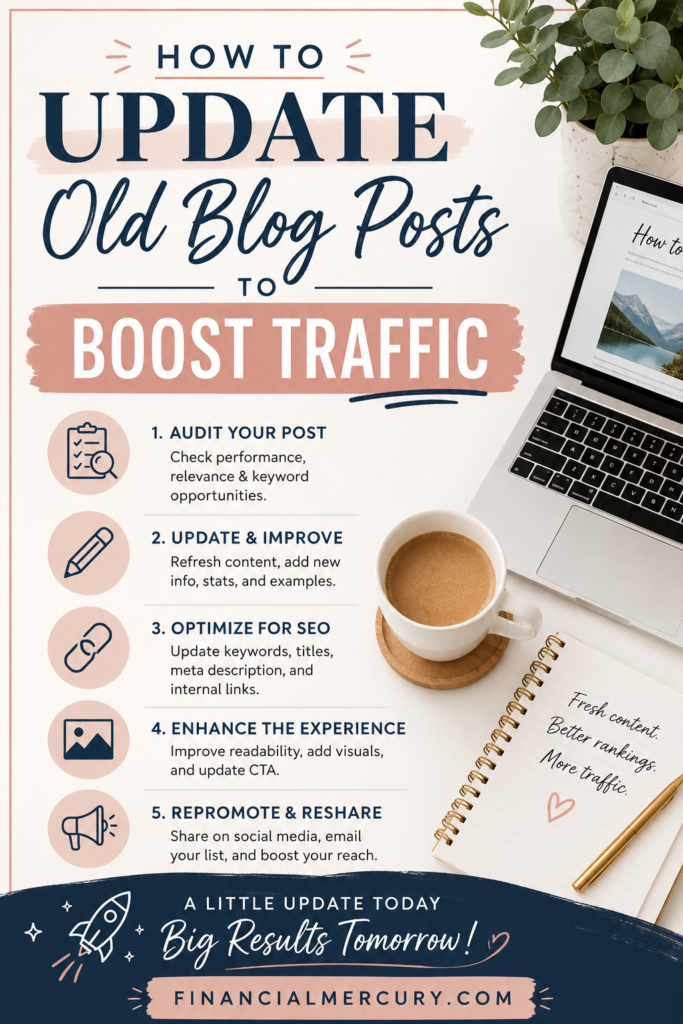
Save the pin for later

- How I Make Money on Pinterest Pinning in 2026 - June 23, 2026
- How to Research Pinterest Keywords for Blog Posts In 2026 - June 23, 2026
- How to Set Up Google Search Console for a Blog - June 23, 2026