
 Onwe Damian Chukwuemeka
B2B content marketing ROI is hard to measure because the path from first click to closed deal is long, messy, and full of touchpoints.
That matters more now, because budgets are tighter and buyers do more self-education before they ever talk to sales. If you can’t show how content supports pipeline and revenue, it’s easy for good work to look like a cost instead of an asset. ROI gets clearer when you track both revenue data and engagement data, then connect the two.
The good news is you don’t need a perfect system to start measuring it well. A simple, practical approach can show which content moves buyers forward, and which pieces need to be changed.
Start with the ROI formula and what it really means in B2B
ROI gives you a simple way to judge whether content is paying off. The formula is easy enough, but the real work is connecting content to revenue in a sales cycle that may take months.
In B2B, ROI is less about a single post and more about the full path it supports. A blog might bring in the first visit, a guide might capture the lead, and a case study might help close the deal. That is why the formula matters, but the tracking behind it matters more.

Use the ROI formula without overcomplicating it
The basic formula is:
ROI = (money made – money spent) / money spent
In content marketing, “money made” is the revenue tied to the content, and “money spent” is the total cost to create, publish, and promote it. If you spend $5,000 on a guide and it helps generate $20,000 in closed revenue, the math looks like this:
($20,000 – $5,000) / $5,000 = 3
That means a 300% ROI. You made three dollars for every dollar spent, after covering the original cost.
A content team can use this with a blog post, webinar, ebook, or campaign. For example, a blog series may not close deals on its own, but it can still produce measurable revenue if leads from that content later become customers. If you want a deeper framework for the return side of the equation, B2B content marketing ROI formulas offer a useful reference point.
The formula is simple. The hard part is deciding which revenue belongs to content and which costs belong in the total.
Separate direct costs from hidden costs
A lot of teams stop at the obvious expenses, and that makes ROI look better than it really is. Direct costs include writing, editing, design, paid distribution, and promotion. Hidden costs include staff time, freelancer fees, software, and the hours your team spends reviewing, revising, and reporting.
A realistic content budget should include:
- Creation costs for writers, editors, designers, and subject-matter support
- Promotion costs for paid social, email tools, and ad spend
- Software costs for SEO tools, analytics, CRM, and project management
- Internal labor for marketing, sales, and approvals
- Production extras like landing pages, visuals, or video edits
If you ignore labor and software, you only see part of the bill. That can make a campaign look profitable when it is really just undercounted. In B2B, full-cost tracking gives you a cleaner picture, especially when content lives inside a broader pipeline process.
Set a fair measurement window for B2B
B2B content rarely pays back on day one. Buyers research, compare vendors, loop in other stakeholders, and revisit content several times before they talk to sales. If you judge a piece too early, you may cut content that is still doing its job.
Some assets create quick results, such as a gated guide that generates leads this month. Others build value over time, like evergreen blog posts or comparison pages that keep sending qualified traffic for quarters. That is why your measurement window should match the sales cycle, not the publishing date.
A practical approach is to review early lead signals first, then check revenue later. For more context on how content feeds traffic over time, Pinterest traffic strategies for revenue show how long-tail content can keep working after launch. If the deal cycle is six months, a 30-day snapshot will miss most of the story.
The right window keeps you honest. It also gives content the time it needs to prove its value.
Choose the metrics that show real business impact
Traffic is useful, but it doesn’t pay the bills. In B2B, the best content metrics show movement toward revenue, not just attention. That means you need to track the full path, from engagement to lead quality to closed deals.
A good rule helps here: if a metric cannot connect to sales decisions, it belongs in a supporting role. The numbers below give you a clearer view of whether content is helping the business grow.

Track revenue metrics before anything else
Revenue metrics give you the clearest answer to a simple question, is content helping the company make money? Start with closed-won deals, because they show the final outcome. Then look at revenue influenced by content, which captures deals where content helped move the buyer forward, even if it was not the last touch.
You should also track pipeline created from content, since that shows how much opportunity content is helping generate. If one guide creates $80,000 in new pipeline and another creates $8,000, the difference matters. The same logic applies to CAC, or customer acquisition cost. When content lowers CAC, it makes the sales engine more efficient.
Another useful metric is revenue per content asset. This tells you which pieces are worth more than their production cost. A case study that supports three enterprise deals is far more valuable than a post that gets traffic and stops there.
These metrics are strongest because they tie directly to business outcomes. They also help you compare content types side by side, so budget decisions get easier. If you need a broader framework for measuring marketing returns, HubSpot’s ROI guide offers a useful reference point.
If a metric can’t help you make a budget or pipeline decision, it shouldn’t lead the report.
Use pipeline metrics to show movement toward sales
Pipeline metrics sit between engagement and revenue, and that makes them useful. They show whether content is helping strangers become sales-ready prospects. That matters because B2B buying cycles usually take time, and content often does the early work.
Watch MQLs to see how many leads content is producing, then check SQLs to see how many of those leads are good enough for sales. Demo requests are even stronger, because they show direct buying intent. Opportunity creation matters too, since it tells you when content helped move a contact into a real sales conversation.
Conversion rates make these numbers more useful. Look at the percentage of visitors who become leads, leads who become MQLs, and MQLs who become opportunities. A page with lower traffic but a higher conversion rate can be more valuable than a popular page that attracts the wrong audience.
This is where content starts acting like a sales assistant instead of a standalone channel. It warms the lead, builds trust, and shortens the path to a conversation. As a result, pipeline metrics help you connect content performance to future revenue, not just current activity.
Treat engagement metrics as supporting evidence
Engagement metrics still matter, but they should support the bigger picture. Time on page, scroll depth, repeat visits, and email click rates show whether people are paying attention. They can tell you a piece is earning interest, which is often the first sign that it may help sales later.
For example, if readers spend more time on a comparison page and scroll all the way down, the content is doing its job. If prospects come back several times before requesting a demo, that repeated attention is a strong clue. Email clicks add another layer, especially when they point to pricing pages, case studies, or product content.
Still, these numbers do not prove ROI on their own. A long time on page could mean interest, confusion, or both. A high click rate is helpful, but it does not equal revenue.
Use engagement data the way you’d use smoke before fire. It helps you see where interest is building, but it doesn’t close the loop by itself. The real value comes when engagement lines up with leads, pipeline, and revenue.
Build tracking so you can connect content to revenue
Connecting your content to actual revenue is the ultimate goal, but it requires a solid technical foundation. You cannot accurately measure ROI if your marketing data sits in one place and your sales data hides in another. By building a unified tracking system, you create a bridge that shows exactly how your blog posts, white papers, and videos influence your bottom line.

Connect your content tools to your CRM
Marketing data needs to live where sales teams spend their time, such as HubSpot or Salesforce. When your content analytics sync with your CRM, you stop looking at isolated clicks and start seeing real prospects. This integration maps specific content touchpoints to individual contact records.
If a prospect reads your case study before they request a demo, that action appears on their profile. This visibility gives your sales team context for their calls and helps you identify which assets actually drive the pipeline. For a three-step matching process that keeps data consistent, you can capture client identifiers in hidden form fields and sync them directly to your CRM. Without this sync, you have no way to prove that your content earned the revenue it helped generate.
Use UTM tags on every trackable link
UTM parameters are the simple tags you add to the end of your URLs to identify where traffic originates. Without these tags, your analytics software just sees “direct” or “referral” traffic, which tells you nothing about which campaign, email, or social post brought the user in. Consistency is your best friend here.
Create a clear naming convention for your tags and stick to it across your blog, email newsletters, and paid ads. If you label a link utm_campaign=q3-nurture, you will immediately see how that specific initiative performs against others.
Keep your structure simple:
- Source: Where the traffic comes from (e.g., newsletter, linkedin).
- Medium: The channel type (e.g., email, cpc).
- Campaign: The specific project (e.g., winter-guide-promo).
These tags act as breadcrumbs that allow your analytics tools to sort and filter performance data. When you add UTM parameters to every distribution link, your reports become significantly cleaner, helping you pinpoint which efforts actually produce value.
Set up clear goals and events in analytics
Good measurement starts with defining what a conversion looks like for your business. If you don’t tell your analytics tool what success is, you will only see raw traffic numbers that don’t help you with ROI. Define specific events for high-value actions, such as demo requests, ebook downloads, or newsletter signups.
Tracking these actions involves setting up events for every meaningful interaction on your site. You should monitor:
- Form completions: Capture exactly what the user signed up for.
- Resource downloads: Identify which white papers or guides attract your best leads.
- Scroll depth: Measure if readers are actually consuming your long-form content.
- Demo clicks: Track the intent to speak with sales.
Focus on actions that signify a shift from casual reader to interested prospect. You can learn more about identifying anonymous accounts to further refine your conversion tracking. Once these goals are live, you have a clear way to see which pages contribute to your pipeline and which ones are just noise.
Use attribution models that match how B2B buyers actually buy
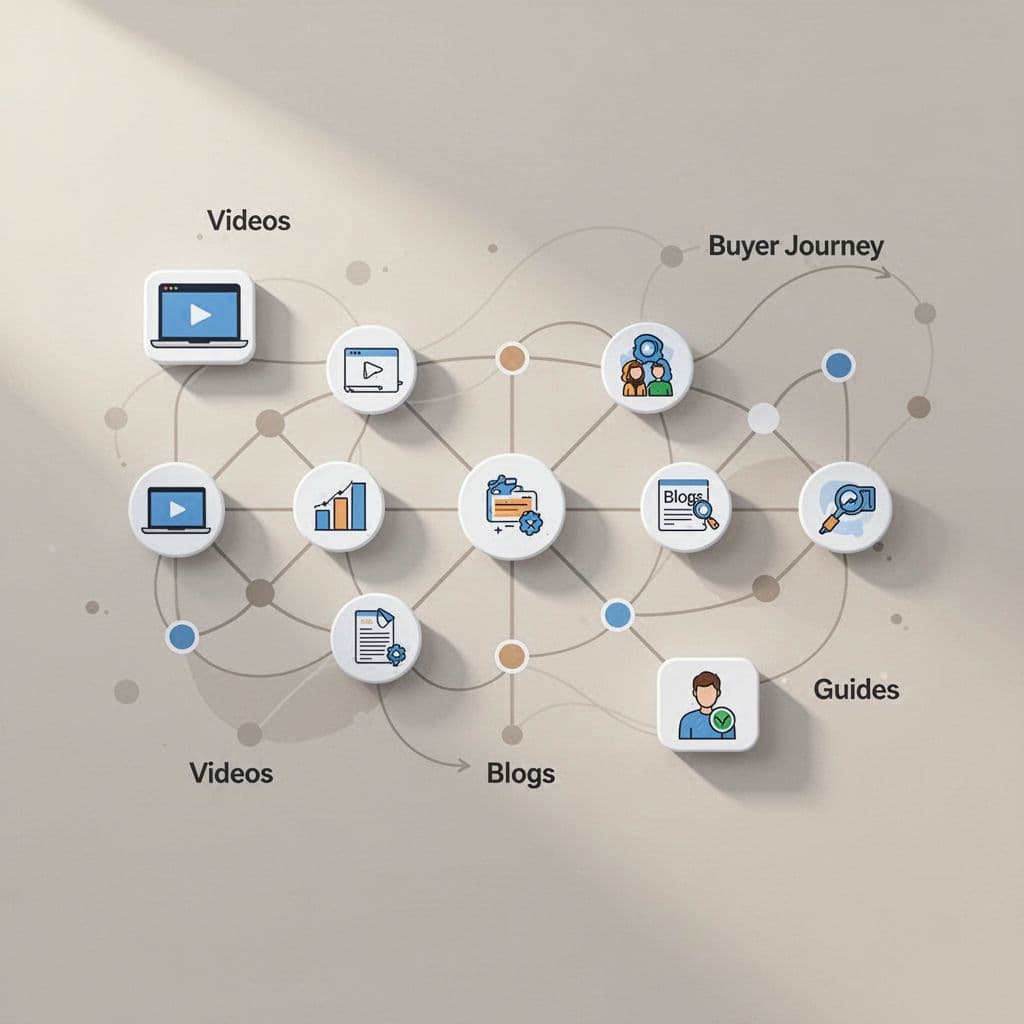
B2B sales involve a complex journey where buyers interact with your brand across many channels over several months. You rarely win a deal because of one single click. Instead, a series of interactions—from blog posts and video tutorials to email nurturing and white papers—builds the trust required for a purchase. If you want to measure ROI accurately, your attribution model must reflect this reality.
Understand first-touch and last-touch credit
Many businesses start with first-touch or last-touch attribution because these models are easy to set up. First-touch models give 100% of the credit to the initial interaction that brought a lead to your site. Last-touch models do the opposite, assigning all value to the final touchpoint before a conversion.
These models offer a simple view, but they create massive blind spots. First-touch tracking ignores the months of nurturing that turn a curious reader into a buyer. Last-touch tracking gives all the glory to the final form submission while forgetting the educational content that convinced the prospect to sign up in the first place. You end up with a skewed report that highlights only the beginning or the end of a long process.
Relying on these models often leads to poor budget decisions. For example, if you assume last-touch is king, you might pour money into retargeting ads while cutting the long-form content that actually generates the pipeline. You are essentially trying to describe an entire movie by watching only the first or last five minutes.
Use multi-touch attribution for a more honest view
Multi-touch models provide a clearer picture by spreading credit across various steps of the buying journey. Options like U-shaped or W-shaped models recognize that different interactions serve different roles. A U-shaped model often weighs the first touch and the lead creation touch heavily, while a W-shaped model adds credit for the opportunity creation stage.
These models better represent how B2B buyers actually shop. In a typical journey, a blog post might spark awareness, a gated guide captures the lead, and a demo or case study pushes the prospect to an opportunity. By using a multi-touch approach, you see which assets contribute to every stage. You stop asking what was the “one thing” that closed the deal and start asking how your content library works together to support the path to revenue.
For teams looking to improve their reporting, marketing attribution models and metrics offer a detailed breakdown of how to weight these touchpoints effectively. Keep in mind that no model is perfect because many B2B interactions, such as peer referrals or private Slack conversations, happen in channels you cannot track. Multi-touch models are simply the best available tool to bridge the gap between activity and revenue.
Pick one model and stay consistent
Choosing an attribution model matters less than sticking with it over time. If you switch between models every quarter, you lose the ability to compare your performance across different time periods. Consistency creates a baseline that allows you to see if your content is actually improving or just looking different on a report.
You should view your attribution model as a standard yardstick for your team. When everyone uses the same math, you can have honest conversations about which campaigns move the needle. Avoid the temptation to change models just to make a specific channel look better.
It is better to have an imperfect model that you understand well than to chase a perfect system that changes every month. Pick a model that aligns with your primary goals, document how you track it, and use it to guide your decisions for at least a year. Reliability is more valuable than precision in the messy world of B2B sales.
Put your content into the sales pipeline so value is easier to prove
Marketing teams often create content in isolation, but that makes it hard to see how it contributes to revenue. When you organize your content by where it sits in the sales pipeline, you turn random blog posts into a structured machine that guides buyers toward a purchase. This approach proves your worth because it connects every piece you publish to a specific job in the sales cycle.

Map content to each stage of the buyer journey
Buyers don’t wake up ready to purchase your service. They go through a logical progression from identifying a problem to selecting a vendor. Your content should match this pace so it stays relevant to what they need at that moment. By tagging your library with these stages, you can map B2B content to buyer thinking and fill any gaps in your current strategy.
- Top-of-funnel content: At this stage, buyers search for answers to general problems. Your blog posts, educational videos, and industry guides should build awareness without pushing a product. The goal is to provide value, establish authority, and capture contact information.
- Middle-of-funnel content: Buyers here know they have a problem and seek solutions. They compare approaches and look for deep analysis. Use webinars, detailed white papers, and research reports to demonstrate how your perspective on the problem is the right one.
- Bottom-of-funnel content: This is where you prove you are the right partner. Prospects need evidence and validation. Focus on case studies, comparison pages that highlight your strengths, and demo videos that show your product in action.
Measure how content helps create and speed up opportunities
Content provides value even when it doesn’t lead to an immediate purchase. It acts as an accelerator that keeps the sales cycle moving. If you can show that deals involving your content close faster than those that don’t, you have a powerful argument for your impact.
Pipeline creation starts when your content converts an anonymous visitor into a known lead. However, the real value appears when sales reps use that content to move prospects between stages. If a rep sends a case study to a stuck prospect and that lead moves forward, your content just influenced a deal.
Track how many opportunities touch specific assets. A deal might be worth more if it interacted with three pieces of high-intent content versus one. When you connect content to the B2B buyers journey, you see clearly how it reduces friction. It prevents prospects from stalling by answering their questions before they feel the need to walk away.
Work with sales to confirm content influence
Data alone rarely tells the full story. Your CRM might show a lead read your latest guide, but a sales conversation reveals what they actually thought of it. You need to align with your sales team to ensure you share definitions for a qualified lead and a healthy pipeline.
Schedule regular sessions to review top-performing assets with your sales counterparts. Ask them which pieces help them get a prospect to commit to the next meeting. Their feedback provides the context that bridges the gap between digital metrics and revenue outcomes. When you both agree on what works, it becomes much easier to prioritize the creation of assets that actually move the needle for the business. This collaboration is one of the most effective strategies for online income generation because it ensures your work supports real-world sales objectives.
Spot the content that actually earns a return
Measuring ROI is not about tallying up every single click. It is about understanding which pieces of content drive your business forward. When you treat all assets as equal, you miss the nuances that make your strategy work. You need to look at specific formats, topics, and long-term performance to identify the true winners.

Compare performance by content type
Different formats serve unique roles in the buyer journey. Comparing a top-of-funnel blog post to a bottom-of-funnel case study is often unfair because they accomplish different tasks. A blog post generates awareness and traffic, while a case study provides the final push needed to close a deal.
You should group your content by format to see how each type supports your revenue goals. This approach prevents you from cutting effective lead-generation pieces just because they don’t produce immediate sales. To get started with a clear framework for these assessments, Content Marketing ROI: How to Measure and Prove the Value of Your Content Program offers practical ways to segment your data.
Consider these roles when you evaluate your library:
- Blog posts and guides: These drive organic traffic and capture early-stage leads. Judge them by lead volume and audience growth.
- Webinars and white papers: These educate prospects in the middle of the funnel. Evaluate them by demo requests and sales-qualified leads.
- Case studies and video testimonials: These build trust during the final evaluation stage. Measure them by win rates and revenue influenced in the pipeline.
Find which topics bring in the best leads
Not every topic attracts the same quality of visitor. Some subjects pull in high-intent buyers who are ready to solve a specific pain point. Others attract general readers who may never convert into customers. You want to identify the themes that consistently put your sales team in front of the right accounts.
Look at your top-converting pages to find patterns in the language and problems they address. If you notice that articles about “integrating data systems” bring in more demo requests than “industry news” pieces, prioritize the integration topics. When you segment performance by topic using your analytics platform, How to Measure Content Marketing ROI With Analytics explains how to categorize these themes to see the full story.
Aligning content topics with search intent is a proven way to improve lead quality. If a user searches for a solution to a specific hurdle, provide the answer clearly. When your content maps directly to a prospect’s urgent needs, your conversion rates will reflect that relevance.
Look for content that keeps paying off over time
Some assets deliver value only for a few days, like a social media post or a temporary promotion. Others act as evergreen engines that generate leads months or years after you hit publish. You need to distinguish between these fleeting efforts and your high-value compound assets.
Evergreen content often sits at the core of a successful SEO strategy. A well-written guide about a persistent industry challenge will continue to rank in search results, bringing in a steady stream of qualified traffic. This ongoing return on investment is exactly what separates a sustainable content program from one that relies on a constant, expensive treadmill of new production.
To see if a piece is earning a return, track its performance over several quarters. Assets that maintain or grow their traffic and conversion numbers over time are the bedrock of your program. While promotional content has its place for short-term spikes, your long-term ROI grows as you invest more in the pages that keep paying off.
Avoid the mistakes that make ROI look better than it is
It is easy to fall into the trap of overestimating your success. When teams report on content marketing, they often cherry-pick metrics that look good on a slide. However, this false confidence hides the truth about what is working and what is wasting your budget. To build a reliable strategy, you must look at your data with a critical eye and avoid these common pitfalls.

Do not judge results from traffic alone
Traffic is a vanity metric that often leads teams astray. It tells you people are visiting your site, but it reveals nothing about who they are or why they are there. You might have thousands of visitors from social media who bounce in seconds. These numbers look impressive in a monthly report, yet they offer zero value to your sales pipeline.
When you judge content purely by page views or impressions, you ignore conversion quality. High volume is only helpful if those visitors turn into qualified leads or, better yet, sales opportunities. If your top-performing blog post attracts thousands of readers who never engage further, that post is a hobby, not a business asset.
Always ask if your traffic is moving the needle. It is much better to have one hundred readers who fit your ideal customer profile than ten thousand visitors who have no intent to buy. For a more detailed look at how to align your goals with actual pipeline results, measure true ROI for pipeline. Focus on the visitors who download your resources, sign up for your product updates, or request a demo.
Do not forget time, labor, and tools in the cost total
Many marketing teams calculate ROI by looking only at direct cash expenses like freelance writing or paid ads. This is a mistake. It drastically understates your true costs and makes your campaigns look more profitable than they really are. When you exclude the “hidden” hours, your math is flawed from the start.
Your total cost of ownership should include every resource that goes into the content. You need to account for internal team salaries, time spent on strategy, meetings, and even software licenses for your marketing stack. If you ignore these, you are lying to yourself about how much it costs to generate a lead.
- Internal labor: Add up the time spent by writers, designers, and subject experts on review cycles.
- Software: Include the monthly cost of every tool used to research, produce, or track the piece.
- Promotion costs: Factor in the spend for paid distribution or time spent on organic outreach.
When you factor in these realities, you get a much sharper view of your unit economics. This honesty allows you to prioritize assets that actually return value above the cost of your team’s time.
Do not stop measuring too early
B2B sales cycles are rarely short. A prospect might read your content for months before they ever reach out to your sales team. If you decide that a piece of content is a failure after thirty days, you are cutting off the long-term potential of your work. Content needs time to rank in search results, build trust with readers, and circulate through a prospect’s organization.
Monthly noise can distort your view of what works. A piece of content that looks quiet in its first month might become a pillar of your lead generation strategy by its third quarter. You should evaluate your assets based on their full lifespan, not just the initial spike in traffic.
To stay grounded, look at trends over several months instead of reacting to immediate fluctuations. Consider the role of content marketing ROI metrics to understand how your assets pay back over time. Giving your content room to breathe allows you to judge its performance based on real impact rather than the impatience of a short-term reporting cycle. When you commit to a longer window, you treat your content as an investment that compounds.
Conclusion
Measuring content marketing success in B2B comes down to how well your assets create pipeline, support sales, and produce revenue over time. While the sales cycle is complex, you can gain clarity by keeping your tracking system straightforward. Define your costs clearly, stick to meaningful metrics that signal buying intent, connect your data to your CRM, and apply your chosen attribution model with discipline.
Better measurement leads to smarter content decisions and more efficient use of your budget. When you show clear links between your work and closed deals, you build lasting trust between marketing and sales. Start with the basics and refine your process as your pipeline grows.
Save pin for later


- How I Make Money on Pinterest Pinning in 2026 - June 23, 2026
- How to Research Pinterest Keywords for Blog Posts In 2026 - June 23, 2026
- How to Set Up Google Search Console for a Blog - June 23, 2026