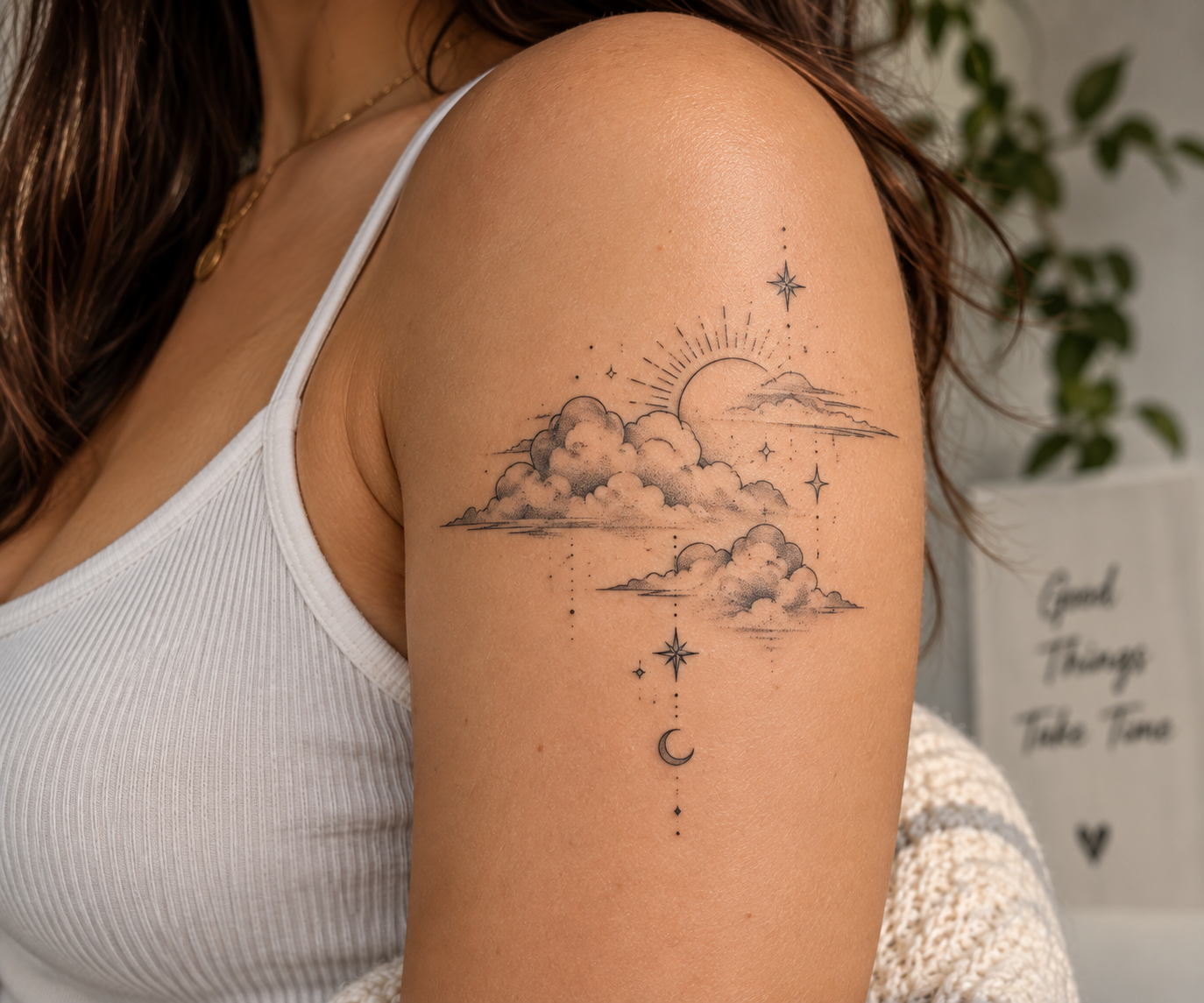
Cloud Tattoo Inspiration: 15 Beautiful Designs, Meanings, and Placements
A cloud tattoo might be the most underrated design in body art. It looks soft and dreamy, but it carries serious range: clouds can symbolize dreams, change, protection, grief, or a fresh start, depending on how you frame them.
That’s also why they work in almost every style. A minimalist single-line cloud sits quietly on a wrist, while realistic storm clouds fill a shoulder with drama. Watercolor versions blur into color like a sky at sunset, and small fine-line pieces pair well with birds, moons, or names.
In this post, you’ll find plenty of cloud tattoo inspiration across styles, plus the meanings behind them, the best placements for different sizes, and tips for designing a piece that feels personal to you. Scroll on and start picturing your own sky.
What a Cloud Tattoo Really Means
Before you pick a design, it helps to know what you’re saying with it. Clouds are one of the few tattoo subjects that change meaning based on the scene around them, so the symbolism is really yours to direct.
Dreams and imagination are the most common association. Clouds sit between earth and sky, soft and unformed, which makes them a natural stand-in for ideas that haven’t taken shape yet. Many people choose them to mark a creative chapter or an ambition still taking form.
Freedom and change run close behind. A cloud drifts wherever the wind takes it, never rooted to one place. If you’ve recently made a big move, left a job, or simply want a reminder to stay flexible, a drifting cloud captures that mindset well.
Calm after the storm is another popular reading, especially when the design shows clouds parting to reveal sun rays or a clear sky. It works as a marker of hard seasons you’ve survived, or as a promise that the weather ahead will be kinder.
Memory of a loved one gives cloud tattoos real emotional weight. Because clouds live in the sky, many people get them to feel closer to someone who has passed. Paired with a name, a date, or a small bird, the tattoo becomes a quiet tribute rather than a plain memorial. Some also blend a cloud with an angel wing or a halo for the same reason.
Cultural context is worth a quick nod. In Japanese tattooing, the kumo often appears as rolling, stylized background work and can represent the flow of nature or impermanence. In Western religious art, clouds frame heaven, angels, and divine presence, which is why they pair so naturally with crosses or praying hands.
Whichever meaning you lean toward, decide on it first. The design (stormy vs. sunlit, solo vs. paired) should follow the message, not the other way around.
Beautiful Cloud Tattoo Designs to Steal for Your Next Ink
Now for the fun part: the designs themselves. Clouds adapt to almost any tattoo style, which means the same subject can read as whisper-quiet or full-blown dramatic depending on how your artist draws it. Here are the looks worth stealing, from barely-there fine line work to pieces that fill a whole shoulder.
Minimalist and Fine Line Cloud Tattoos
Fine line clouds are exactly what they sound like: a single thin line that loops and bumps into the shape of a cloud, usually no bigger than a coin. Artists draw them with a single needle, so the result stays crisp and delicate. They sit beautifully on the wrist, ankle, or behind the ear, and most people forget they’re even showing it off until someone asks.
They’re also the go-to choice for matching tattoos. Two friends might each carry half a cloud, the design only complete when you stand side by side, or a couple might get identical small clouds to mark a trip or a shared song lyric. Because there’s so little ink and no heavy shading, these pieces age gracefully; a fine line cloud at year ten still looks like the day you got it, just slightly softened.
Realistic Storm Clouds and Black and Gray Work
If fine line is a whisper, realism is the thunder. Black and gray storm clouds use dense shading and smooth gradients to build volume, often with a lightning bolt splitting the middle or rain falling in fine parallel lines. Done well, the cloud looks three-dimensional, almost like smoke trapped under your skin.
The real secret is shading, not outlines. A cloud in nature has no hard edges; it’s just light and shadow in layers. That’s why a skilled artist builds them up in gradations, letting the darkest mass fade into open skin so the piece looks like it’s floating. Storm clouds work especially well on the shoulder, forearm, or calf, where there’s room for the darkness to roll into light. Many people choose this style to represent a rough period they came through, and the contrast of heavy black lifting into clear skin tells that story on its own.
Watercolor, Sun and Moon Cloud Combinations
Watercolor clouds swap black ink for loose washes of color that bleed past the cloud’s edges, like the sky caught mid-sunset. Pinks and oranges feel warm and hopeful, while blues and purples lean moody and calm. One thing to know: watercolor styles rely on light pigment, so they can fade faster than dense blackwork and benefit from touch-ups.
Clouds also shine when paired with other sky elements. Some popular combinations include:
- A crescent moon tucked into the cloud for night-sky energy
- Sun rays breaking through, symbolizing hope after hardship
- Scattered stars or a small rainbow for a lighter, playful feel
Each pairing shifts the mood. Sun and cloud reads as optimism, moon and cloud as calm or remembrance, and stars as dreams worth chasing. Pick the sky that matches your story.
Where to Put It: Best Placements for Cloud Tattoos
Placement matters more with clouds than with most designs. Because clouds have soft, rounded edges and no hard outline, they need a body area with enough curve and space to let the shape breathe. A cramped spot forces your artist to shrink the design, and a tiny cloud loses the soft gradients that make it look like it’s floating. Think of placement as choosing the frame before the painting.
Forearm, Shoulder, and Thigh: Canvas Spots That Fit Cloud Shapes
The forearm is the most popular home for a cloud tattoo, and for good reason. The long, flat stretch of skin suits horizontal designs like a cloud bank, rain falling from a cloud, or sun rays cutting through. It’s also easy to show or cover with a sleeve, which matters if your workplace has rules about visible ink.
The shoulder works best for bigger, dramatic pieces. The round muscle gives storm clouds natural volume, and the design can wrap over the curve toward the chest or back. Black and gray realism especially shines here because the shading has room to roll from dark into open skin.
The thigh offers the largest smooth canvas, which makes it ideal for wide scenes: a full sky with clouds, a moon tucked behind them, or layered clouds in watercolor washes. The ribcage is a fourth option if you want something private and have a high pain tolerance, since the skin there is thin and sits right over bone.
Wraparound designs deserve a mention too. A band of clouds circling the forearm, ankle, or upper arm follows the body’s natural lines and looks cohesive from every angle.
Small Spots: Wrist, Ankle, and Behind the Ear
Not every cloud needs a large canvas. A small fine-line cloud fits neatly on the wrist, the ankle, or the collarbone, and these spots suit minimal designs best: a single outline, a tiny cloud with one star, or a two-cloud matching tattoo.
Keep expectations realistic at these sizes. Detail drops fast below two inches, so skip heavy shading and rain lines; your artist can suggest what will still read clearly after healing. Pain runs higher on bony spots like the ankle, wrist, and behind the ear, where there’s little fat to cushion the needle. Most people describe it as sharp but quick, since small pieces take 15 to 30 minutes.
One practical tip: bony and high-movement areas fade a bit faster, so a slightly bolder line holds up better than a whisper-thin one.
How to Choose the Right Cloud Tattoo for You
By now you’ve seen the styles and the placements, so the last step is narrowing it down to your design. A few practical decisions will get you there: what the tattoo means to you, whether it lives in black and gray or color, and who holds the needle. Work through them in order and the right design usually picks itself.
Start With the Meaning, Then the Style
Decide what the cloud represents before you touch a design board. Grief, freedom, a creative chapter, calm after a hard season: each points toward a different look. A memorial piece might call for a soft cloud with a small bird, while a “storm survived” story suits heavy black and gray with light breaking through. When the meaning leads, the style follows naturally, and you end up with something personal instead of pretty-but-generic.
Black and Gray or Color?
This choice shapes everything, including how the tattoo ages. Black and gray work heals predictably and holds its contrast for decades, which is why realism artists favor it. Color gives you sunset washes and watercolor softness, but lighter pigments (pinks, yellows, pale blues) fade faster and often need touch-ups within a few years. Sun exposure speeds that up, so think honestly about where the tattoo sits and how much sun it will see. If you want color with less maintenance, ask your artist to anchor the design with some black linework or shading.
Vet the Artist’s Portfolio, Not Just the Shop
Clouds live or die on soft shading. There’s no hard outline to hide behind, so look for an artist whose portfolio shows smooth gradients, believable smoke, or skies, proof they can blend ink into skin without harsh edges. Bring two or three references to your consultation: a photo of the shading style you like, a placement shot, maybe a color palette. Good artists use references as a starting point, then adapt the design to your body.
That brings up one more thing: custom beats copied. Pinterest art is a great way to communicate what you want, but a design lifted straight from someone else’s skin (and someone else’s artist) rarely fits your shape or your story. A custom piece costs a little more and takes longer, and it’s yours alone.
Finally, picture the tattoo in ten years. Fine lines soften, color mutes, and bolder elements stay crisp. Choose a design that will still look good softened, and you’ll never regret it.
How to Care for Your Cloud Tattoo So It Stays Soft and Sharp
A cloud tattoo lives on its gradients, so aftercare matters more here than with a bold outlined design. If the shading blurs or dries out, the whole piece loses its float. The good news: the routine is simple once you know the rules.
The First Two Weeks
Follow your artist’s instructions first; they know how their ink healed on hundreds of clients. In general, keep the wrap on for the time they specify, wash gently with fragrance-free soap, and pat dry with a clean paper towel. Apply a thin layer of unscented moisturizer two or three times a day. Thin is the key word. A thick coat suffocates the healing skin and can pull ink out.
Skip pools, gyms, lakes, and direct soaking for at least two weeks. Bacteria and bacteria-laden water are the fastest way to ruin fresh work. Itch and light flaking are normal; never scratch or pick.
Sun Protection and Long-Term Maintenance
Sun is the real long-term enemy. UV rays break down pigment, and pale gray fades first, which matters because your storm clouds depend on those middle tones. Once the tattoo is fully healed, treat it like a permanent passenger on your skin: any day you’d put sunscreen on your face, put SPF 30 or higher on your tattoo. Reapply after swimming or heavy sweating.
Lighter gray shading may soften over the years and occasionally needs a touch-up session to restore contrast. That’s expected with black and gray realism, especially on high-movement spots like the shoulder.
Moisturized skin also displays shading better, so keep lotion in your routine beyond healing. If you’re still comparing styles, browsing fine line cloud designs before your appointment helps you plan for the upkeep each one needs.
Conclusion
A cloud tattoo is one of the few designs that can hold grief, hope, freedom, or a fresh start in a single shape. The meaning is yours to set, and the style follows from it: fine line for something quiet, black and gray for a storm you survived, watercolor for a sky worth remembering.
The strongest takeaway is simple. Choose the design that tells your story, not the one that fills a feed fastest. Pair it with a placement that gives the shading room to breathe, and it will age into something you’re still proud of years from now.
Your next step is a consultation. Bring your references, ask to see a portfolio full of soft gradients, and let a skilled artist adapt the idea to your skin. The right sky is waiting.
Save pin for later


- Hunting Gothic Skin: What the Search Term Can Mean - September 25, 2026
- Skull Tattoo Designs for Men That Stay Bold Over Time - September 25, 2026
- 30 Tips to Find Your Perfect Tattoo Style and Artist - September 25, 2026
Leave a Reply