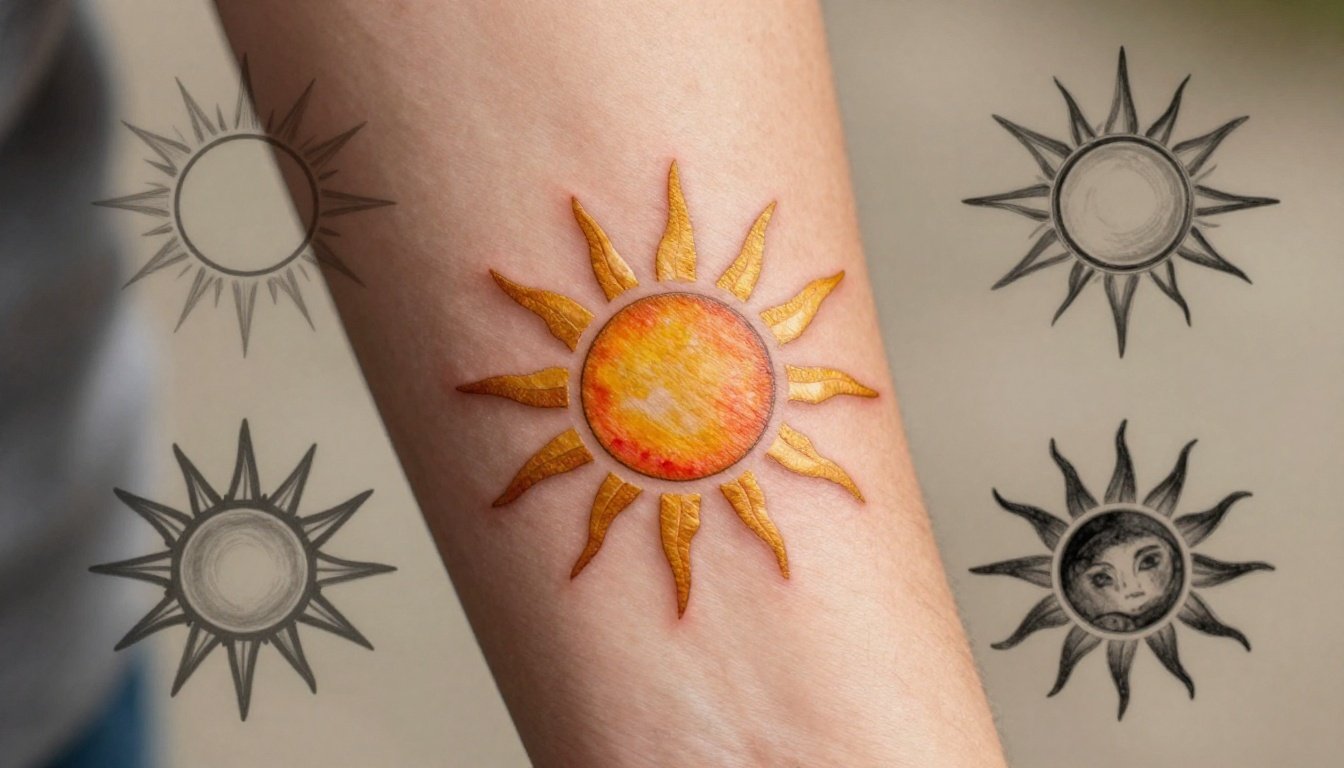
100 Gorgeous Sun Tattoo Ideas for Every Style
A sun tattoo can bring a little light to your skin, carrying the warmth of summer, the courage to begin again, or the calm promise of a fresh start. Whether you picture fine rays at your wrist or a glowing sun across your shoulder, the right design can hold a personal meaning while still looking beautiful.
This collection features 100 sun tattoo ideas across minimalist, bold, colorful, spiritual, traditional, and nature-inspired styles. Save the details that catch your eye, then combine shapes, rays, colors, celestial elements, or meaningful symbols to create a design that feels like yours.
Along the way, you’ll find guidance on symbolism, placement, personalization, cultural respect, pain planning, and aftercare, including why a healing tattoo needs shade and clothing instead of sunscreen until the skin closes.
Start with these sun tattoo ideas and find the details that make your vision shine.
Watch sun tattoo ideas and meanings
Key Takeaways
- Choose a sun tattoo style that fits your personality, whether you prefer fine-line simplicity, bold traditional ink, celestial symbolism, or colorful artwork.
- Personalize the design with rays, moons, flowers, faces, stars, or meaningful dates to create a tattoo with lasting significance.
- Consider placement carefully, since tattoos on sun-exposed areas need regular protection to help prevent fading.
- Wait until a new tattoo heals before applying sunscreen. Afterward, use broad-spectrum, water-resistant SPF 30 or higher, as recommended by the American Academy of Dermatology.
100 Gorgeous Sun Tattoo Ideas
Sun tattoos can be delicate, dramatic, geometric, celestial, or deeply personal. Use these concepts as starting points, then adjust the size, line weight, colors, and placement to suit your skin and story.
Minimalist and Delicate Sun Tattoos
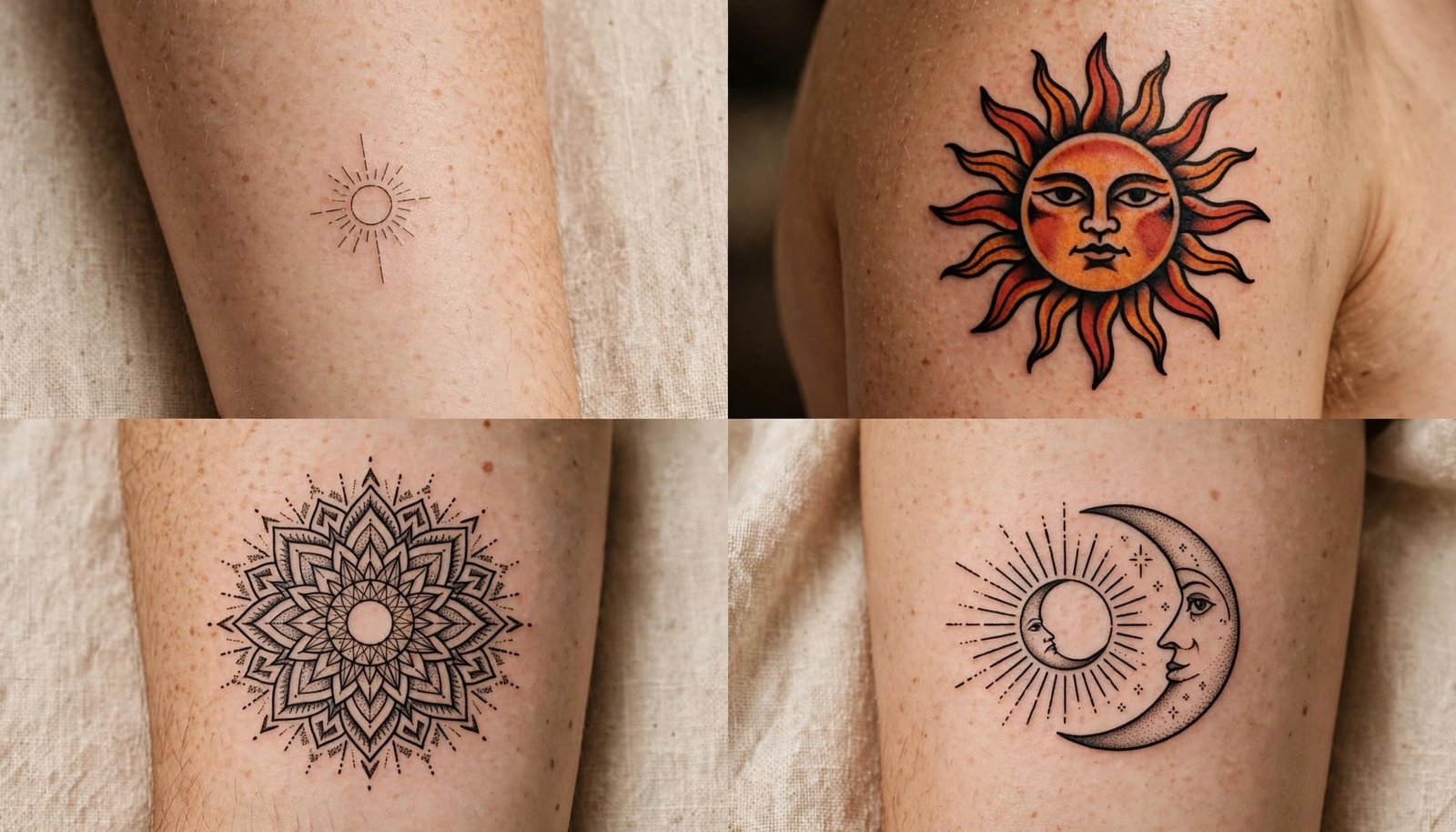
Small sun tattoos work well on the wrist, finger, ankle, behind the ear, and collarbone. Fine lines create a soft look, but they may become lighter or less crisp over time, especially with frequent sun exposure. Protect healed tattoos with broad-spectrum, water-resistant SPF 30 sunscreen.
- Tiny Outline Sun: A small open circle with short rays suits discreet placements.
- Fine-Line Rays: Narrow rays create an airy design for the wrist or inner arm.
- Half Sun: A rising half-circle fits neatly along the ankle or collarbone.
- Horizon Sunrise: Add one straight horizon line beneath the sun for a calm landscape.
- Behind-the-Ear Sun: A tiny outline stays hidden until you tuck back your hair.
- Wrist Sun: Place a simple round sun above the wrist crease for an everyday reminder.
- Finger Sun: Use a miniature circle and three or four rays on the side of a finger.
- Ankle Sun: A fine-line sun near the ankle bone creates a subtle summer-inspired accent.
- Collarbone Sun: Stretch delicate rays along the collarbone for an elegant placement.
- Sun With Dots: Replace several rays with tiny dots for a softer, decorative finish.
- Single-Line Sun: Draw the circle and rays in one continuous flowing line.
- Crescent Sunrise: Shape the sun as a curved sliver rising above a short horizon.
- Sun With a Tiny Heart: Place a small heart inside the center for a personal love symbol.
- Sun With Initials: Add one discreet initial beneath the circle or inside its center.
- Sleeping Sun Face: Give the small sun closed eyes and a peaceful curved mouth.
- Geometric Mini Sun: Build the design from a circle, triangles, and evenly spaced lines.
- Sun With One Word: Add a short word such as “hope,” “brave,” or “bloom” beneath it.
- Tiny Sun and Moon: Pair two small symbols to suggest balance and changing seasons.
- Minimalist Eclipse: Place a black dot over a thin outlined sun for a clean eclipse image.
- Small Sunburst: Use alternating long and short rays for a neat burst with visual rhythm.
Bold Traditional and Fiery Sun Designs
Bold outlines and limited colors often keep traditional tattoo designs readable for years. Black, red, orange, and muted gold provide strong contrast without overcrowding the skin.
- Old-School Sun: Use a heavy black outline and evenly spaced pointed rays.
- Burning Red Sun: Blend red and orange rays for a hot, energetic appearance.
- Blackwork Sunburst: Fill the center with solid black and leave sharp rays unshaded.
- Vintage Sun Face: Add a calm or stern face inside a classic golden sun.
- Rising Sun Banner: Place a curved banner beneath the sun for a name or date.
- Fiery Cloud Sun: Let orange rays break through dark, rounded clouds.
- Bold Shoulder Sun: Use the shoulder’s curve to create a large, radiating centerpiece.
- Traditional Chest Sun: Set a symmetrical sun across the chest with strong red accents.
- Flame-Ray Sun: Replace pointed rays with curling flame shapes for a fierce silhouette.
- Distressed Black Sun: Add small gaps and rough edges for an aged, woodcut effect.
- Golden Sunset: Combine muted yellow, burnt orange, and a thick dark outline.
- Sun With a Crown: Place a simple crown above the center for confidence and leadership.
- Lion-Faced Sun: Give the sun a lion’s mane and a focused expression.
- Warrior Sun: Add a helmet, shield, or determined face without crowding the rays.
- Sun With a Sword: Run a sword vertically through the center for strength and resolve.
- Radiant Forearm Sun: Use the forearm’s length for extended rays and balanced symmetry.
- Sleeve Centerpiece: Build a large sun that connects smaller stars, flames, or clouds.
- Sun With Stars: Surround a bold sun with a few solid stars for classic tattoo energy.
- Quote Banner Sun: Add a short phrase on a traditional ribbon beneath the design.
- High-Contrast Eclipse: Pair a black disk with a bright red or orange ring of light.
Geometric, Mandala, Dotwork, and Blackwork Suns
Pattern-heavy sun tattoos need careful spacing. Match the detail to the tattoo’s size, and choose an artist who regularly works with symmetry, dotwork, and precise line weight.
- Mandala Sun: Arrange petals and rays around a centered circular core.
- Concentric Circles: Layer several circles to create a hypnotic, balanced design.
- Sacred Geometry Rays: Use repeated geometric angles around a clean central disk.
- Triangular Rays: Build the sun with sharp triangles for a modern architectural look.
- Dotwork Sun: Create shading with gradually spaced dots instead of solid fills.
- Stippled Eclipse: Use dense stippling around a dark center to suggest glowing light.
- Black Geometric Sun: Combine solid black shapes with thin negative-space lines.
- Repeating Petal Sun: Form every ray from the same petal shape for perfect rhythm.
- Compass Sun: Blend compass points with sun rays for a travel-inspired design.
- Hexagon Sun: Frame the center inside a hexagon and extend short rays outward.
- Ornamental Sternum Sun: Place a symmetrical jewel-like sun beneath the chest.
- Back Sun: Use the spine as the centerline for a large, balanced design.
- Maze-Ray Sun: Fill each ray with a winding maze pattern for visual complexity.
- Negative-Space Sun: Leave the sun light while shading the surrounding background.
- Geometric Planets: Add tiny circles and orbit lines around the main sun.
- Circular Sun Jewel: Make the center resemble a faceted gemstone with pointed rays.
- Respectful Symbol Sun: Add researched sacred symbols only with cultural care and permission.
- Split Geometric Sun: Divide the design into contrasting halves, such as lines and dots.
- Filigree Sun: Surround fine rays with curling ornamental details.
- Black-and-Gray Sun: Use charcoal shading and crisp black outlines for a refined finish.
Sun and Moon, Nature, and Celestial Pairings
Pairing a sun with another image can create a fuller scene. Meanings vary by person, so let balance, growth, travel, freedom, or connection to nature guide your choices rather than treating any symbol as universal.
- Sun-and-Moon Balance: Place both shapes side by side in a symmetrical composition.
- Overlapping Faces: Give the sun and moon contrasting expressions within intersecting circles.
- Mountain Sunrise: Set a warm sun behind pointed mountains for an adventurous landscape.
- Ocean Sun: Add horizontal waves beneath the sun for a peaceful coastal scene.
- Wildflower Sun: Surround fine rays with small flowers and loose stems.
- Cloud-Wrapped Sun: Let soft clouds partially cover the rays for a dreamy mood.
- Ringed Planet Sun: Pair the sun with a small planet and a delicate orbit ring.
- Solar System: Arrange tiny planets around a central sun in a compact vertical design.
- Stars and Constellations: Add selected stars that connect to a meaningful constellation.
- Desert Sun: Combine a low sun with dunes, cactus shapes, or distant mesas.
- Sunflower Sun: Blend sunflower petals with solar rays for a bright growth theme.
- Forest Sun: Place the sun behind pine trees for a calm wilderness image.
- Butterfly Sun: Let a butterfly cross the rays for a symbol of change and freedom.
- Sun With Birds: Add small birds in flight to create movement across the design.
- Sun and Compass: Combine a compass needle with rays for travel and direction.
- Sun With an Eye: Place an eye in the center as a personal image of awareness.
- Sun and Waves Circle: Enclose rays and ocean waves inside one clean circular frame.
- Crescent, Sun, and Clouds: Layer a crescent moon beside soft clouds and thin rays.
- Celestial Shoulder Piece: Connect stars, moons, planets, and a sun across the shoulder.
- Nature Sleeve Centerpiece: Make the sun the focal point among trees, flowers, and animals.
Mythic, Spiritual, Personalized, and Unusual Sun Concepts
Meaningful sun tattoos become stronger when you develop an original interpretation. Research any sacred or culturally specific imagery before using it, and avoid copying patterns whose history you don’t understand.
- Helios-Inspired Sun: Use a classical profile, flowing hair, and horse-like rays as loose inspiration.
- Egyptian-Style Ra Reference: Pair a solar disk with carefully researched Egyptian motifs.
- Amaterasu-Inspired Sun: Create a respectful Japanese-inspired concept after studying the tradition.
- Protective Sun Shield: Shape the rays around a shield for a guardian-like image.
- Meaningful Date Sun: Hide a birth, recovery, or anniversary date within the rays.
- Birth Flower Sun: Replace several rays with the birth flower of someone important.
- Family Constellation Sun: Connect small stars representing family members around the center.
- Zodiac Sun: Add a personal zodiac symbol without overcrowding the circular design.
- Meaningful Word Sun: Write one short word along the lower curve.
- Lion Sun: Combine a lion’s profile with a radiant mane.
- All-Seeing Eye Sun: Place an eye at the center for personal awareness or faith.
- Phoenix Sun: Let a phoenix rise through the rays as an image of renewal.
- Sun From Darkness: Show bright rays breaking through a black background.
- Rebirth Sun: Add fresh leaves growing from the lower edge of the disk.
- Protective Serpent Sun: Wrap a serpent around the rays with careful cultural research.
- Portrait Silhouette Sun: Place a small loved one’s profile inside the center.
- Handwritten-Ray Sun: Turn a loved one’s handwriting into the outer rays.
- Half-Hidden Sun: Cover part of the design with leaves, clouds, or a dark arc.
- Personal Mantra Sun: Curve a short private mantra around the outside.
- Custom Symbol Sun: Combine dates, flowers, stars, initials, and shapes with your artist’s guidance.
The best design balances meaning with clear tattoo structure. Bring your artist a few favorite ideas, then let them adjust spacing, line weight, and scale for the placement you choose.
What Does a Sun Tattoo Mean? Symbolism From Hope to Inner Power
A sun tattoo can hold many meanings, but no single definition fits everyone. For one person, it may honor recovery after a difficult season. For another, it may express confidence, spiritual connection, or the simple joy of feeling alive.
Your choice of rays, colors, surrounding images, and placement shapes the message. A soft sunrise feels different from a blackwork sunburst, even though both use the same central symbol. Before choosing a design, consider the feeling you want to carry with you every day.
Light, Hope, Clarity, and New Beginnings
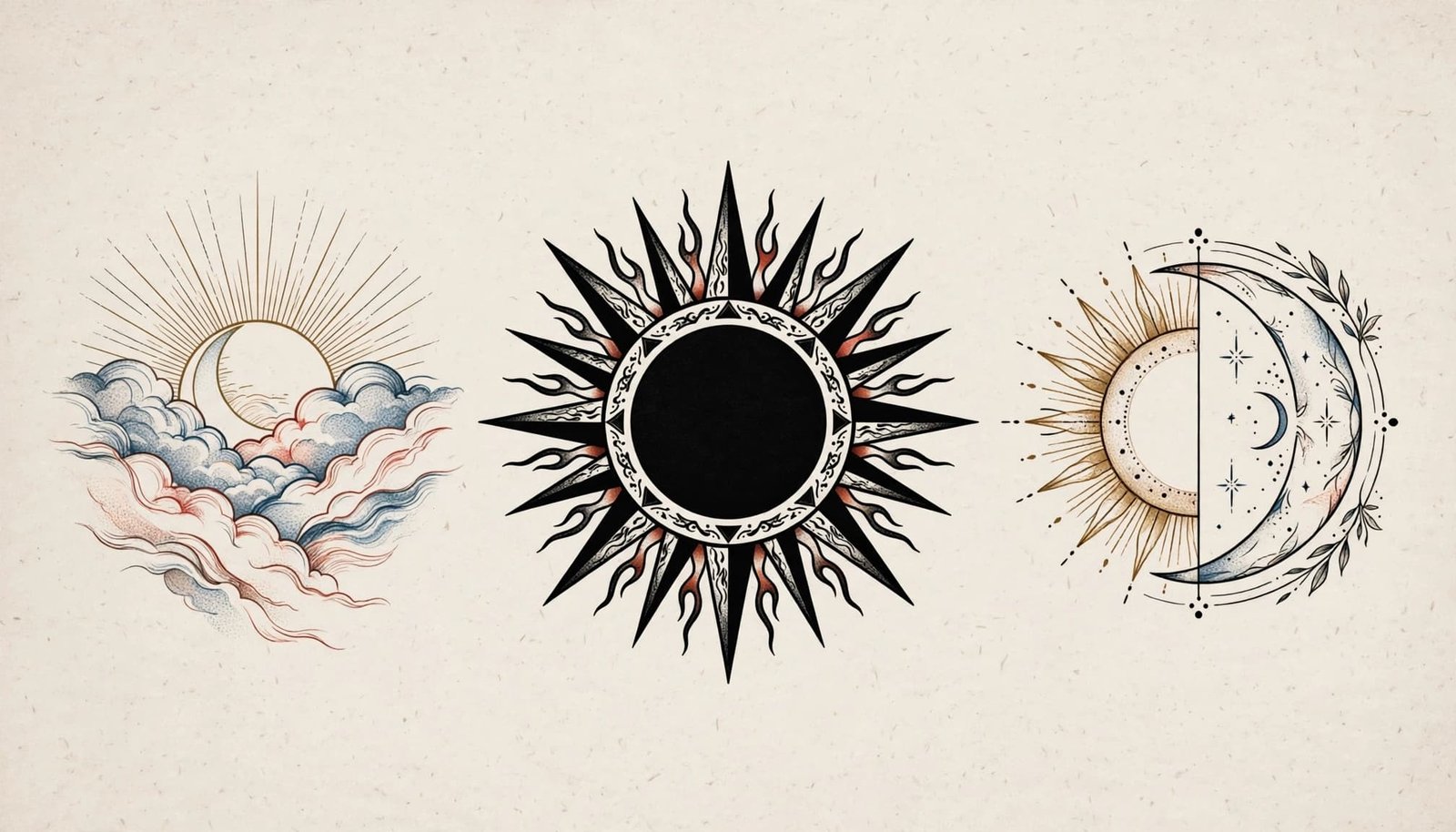
Many people connect the sun with light after darkness. A sunrise can honor the moment you began healing, left an unhealthy situation, or chose to move forward after a major life change. Its meaning feels personal because the image captures movement, the night has passed, and something brighter is beginning.
Open rays often suggest honesty, truth, and mental clarity. You might choose thin rays spreading evenly from a clean central circle to symbolize a decision that finally became clear. A sun emerging from clouds can carry a more specific story, especially if life still feels complicated but hope has returned.
Color also changes the mood:
- Soft yellow and peach can create a gentle image of healing and peace.
- Pale orange may suggest warmth, energy, and a new chapter.
- Blue-gray clouds can acknowledge a difficult past without allowing it to cover the entire design.
- White or uninked space can give the sun a clean, open feeling.
For a recovery tattoo, consider a half sun rising above a horizon line, fresh leaves growing beneath the disk, or small birds leaving the rays. Someone celebrating sobriety, survival, or emotional healing might choose a sun breaking through heavy clouds. If you are honoring a new beginning, add a meaningful date in tiny lettering or use a birth flower as one of the rays.
The design doesn’t need to look dramatic to carry a strong message. A small wrist sun can become a daily reminder to choose hope. A fine-line sunrise along the collarbone can suggest that you are still becoming the person you want to be.
Strength, Vitality, Courage, and Protection
A sun tattoo can also express life force, confidence, and the courage to take up space. Fiery rays create a more intense mood than rounded rays, especially when the artist uses red, orange, or deep gold. Bold blackwork produces another kind of strength through solid shapes, sharp contrast, and a design that remains visually firm from a distance.
Placement can reinforce that feeling. A central chest sun may feel protective, as though it guards the heart. A large back tattoo can turn the body into a broad canvas for radiating power, while a shoulder sun can follow the curve of the muscle and create a strong focal point.
You might personalize this meaning with:
- A lion’s face or mane for courage, leadership, and personal authority.
- A shield around the sun for protection and emotional boundaries.
- Flame-shaped rays for determination, transformation, or survival.
- A sword through the center for resolve after a difficult choice.
- Heavy black lines for a grounded, confident appearance.
These details don’t carry one fixed message. A lion sun may honor family strength for one wearer and personal independence for another. Likewise, a shield may symbolize protection from outside harm, protection of loved ones, or a promise to protect your own peace.
The strongest sun tattoo is often the one that connects an impressive design with a private reason only you fully understand.
Consider how the tattoo will feel years from now. If you want confidence without an aggressive appearance, use rounded rays, warm colors, and a calm facial expression. For a bolder statement, choose pointed rays, blackwork shading, and a larger placement across the chest, back, or upper arm.
Balance, Rebirth, and Spiritual or Mythic Meaning
Sun-and-moon tattoos often suggest balance because they place brightness beside darkness, activity beside rest, or outward confidence beside inner reflection. Some people use the pairing to honor two sides of their personality. Others connect it with a relationship, changing seasons, or the need to make room for both strength and softness.
The composition matters. A symmetrical sun and moon can suggest harmony, while overlapping faces may show connection between contrasting forces. A sun rising behind a crescent moon creates a more unusual image, especially when you want the tattoo to suggest transition rather than perfect balance.
Rebirth imagery can make the meaning more personal. Plants growing from a sun may point to recovery and steady growth. Birds crossing the rays can suggest freedom after feeling trapped. Flames can describe destruction followed by renewal, while a rising sun over water or mountains may symbolize a new direction.
Sun tattoos can also draw on mythic figures, but research matters before using a religious reference. In Greek mythology, Helios is the sun deity associated with driving a horse-drawn chariot across the sky. In ancient Egyptian religion, Ra is a creator and solar deity connected with life, the sky, and the underworld. Amaterasu-Omikami is a Shinto sun deity honored at Ise Jingu in Japan. These figures belong to distinct traditions, so they shouldn’t be treated as interchangeable versions of a generic sun god. Britannica’s overview of sun worship offers useful background, while the Horniman Museum’s guide to sun gods provides further cultural context.
Before choosing a deity’s name, face, sacred object, or traditional motif, learn what the imagery means within its culture. A simple sunburst may be your personal symbol, while a reference to Amaterasu, Ra, or Helios carries a more specific history. Cultural respect begins with knowing the difference.
Your personal story remains the clearest meaning of the tattoo. Let the image show what you want to remember, whether that is the first hopeful morning after a painful chapter, the strength to protect your peace, or the courage to begin again.
Sun Tattoo Styles That Change the Mood of Your Design
The same sun can feel delicate, fierce, mystical, playful, or almost photographic depending on the artist’s choices. Line weight controls visual strength, color sets the temperature, shading adds depth, and pattern determines whether the design feels calm or ornate.
Before choosing a reference image, decide how you want the tattoo to read at a glance. A tiny outline sun may suit a discreet placement, while a bold blackwork or realistic design needs more room to stay clear. Your preferred style should also match your tolerance for upkeep, the tattoo’s exposure to sunlight, and the level of detail you want to preserve over time.
Fine-Line, Minimalist, and Tiny Sun Tattoos
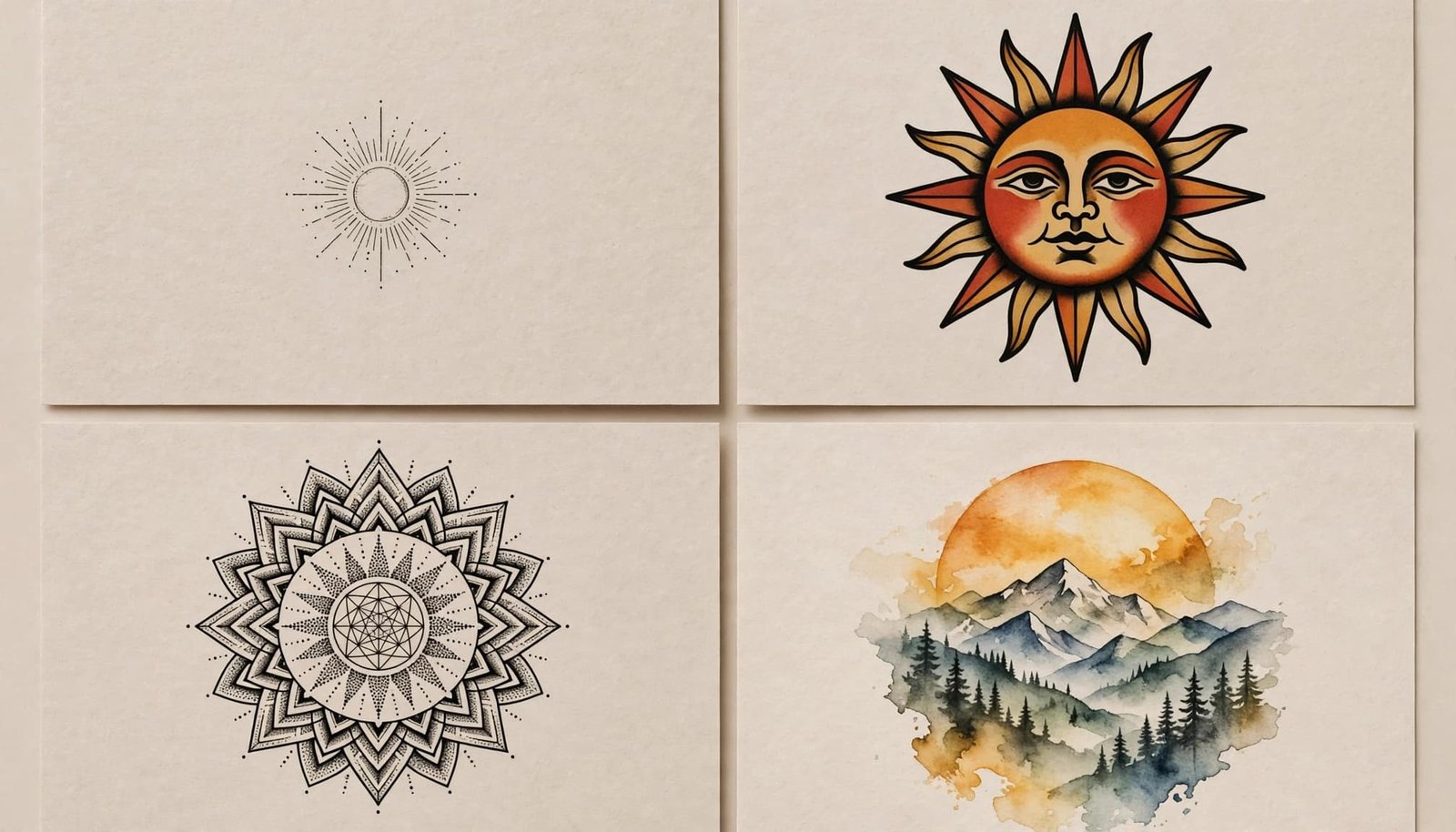
Fine-line sun tattoos use clean outlines, narrow rays, and open skin to create a light, modern appearance. Sparse rays can make a small design feel airy, while tiny dots add texture without making the image look heavy. A simple circle with four rays may feel peaceful and discreet, whereas a single-line sun can look more artistic and fluid.
Small designs work well behind the ear, on the wrist, along the ankle, or near the collarbone. They also suit people who want a personal symbol that doesn’t dominate their overall look. However, size limits detail. Tiny faces, tightly packed rays, miniature lettering, and complex patterns may blur together as the tattoo ages.
Fine lines can also lose their crisp appearance sooner than bold shapes, especially on fingers, feet, elbows, or other areas exposed to friction and frequent sunlight. Healed skin needs protection, and MD Anderson’s tattoo sun-care guidance explains why sunscreen matters once the tattoo has fully healed.
Ask to see an artist’s healed fine-line work, not only fresh photographs. An experienced tattooer can simplify the design, adjust the line weight, and leave enough breathing room for the image to remain readable.
Traditional, Neo-Traditional, and Colorful Sun Tattoos
Traditional sun tattoos rely on bold outlines, strong silhouettes, and a limited color palette. Classic pointed rays, thick black borders, and flat red, orange, or yellow fills give the design a confident, vintage feel. Because the shapes are clear and the contrast is strong, this style often remains readable from a distance and suits larger forearm, shoulder, chest, or calf placements.
Neo-traditional sun tattoos keep the strong outline but add more depth. The artist may use curved rays, layered shading, ornamental leaves, jewels, clouds, or decorative framing. Richer color blends can make the sun appear dimensional without pushing it toward full realism. Deep red beside burnt orange creates heat, while ochre and muted gold feel warmer and more weathered.
Color changes the emotional temperature of the design:
- Bright yellow and orange create an energetic, cheerful mood.
- Red and black make the sun feel intense, dramatic, or protective.
- Gold and ochre give it an antique, celestial quality.
- Peach, rust, and dusty rose suggest a softer sunset.
- Muted colors can suit vintage clothing, neutral wardrobes, or a more understated tattoo collection.
Your skin tone should guide the final palette, but it shouldn’t limit your choices. Ask the artist which hues will provide enough contrast and how they expect those colors to heal. Personal style matters just as much. A saturated neo-traditional sun may suit someone who enjoys visible color, while a restrained palette can work better for a design intended to age quietly beside existing black ink.
Geometric, Mandala, Dotwork, and Blackwork Styles
Geometric sun tattoos feel crisp because they depend on repeated angles, clean circles, and measured spacing. Mandala designs add petals, rings, and ornamental symmetry, turning the sun into something closer to a sacred-looking jewel. These styles suit sternums, backs, upper arms, and thighs, where the artist has enough space to establish a clear centerline.
Dotwork softens that structure. Instead of relying on solid shading, the tattooer builds shadows with clusters of dots that become lighter as they spread outward. A dotwork sun can feel earthy, meditative, or softly textured. It also pairs well with mountains, moons, plants, and celestial patterns.
Blackwork creates the strongest visual impact. Solid black rays, dark centers, or heavy surrounding shapes give the tattoo a graphic quality that can remain legible across a room. Negative space prevents dense areas from becoming one dark block, so spacing matters as much as the ink itself.
Symmetry can make a sun tattoo look effortless, but the stencil placement must be exact before the needle touches skin.
For a mandala or geometric design, check the stencil from several angles and ask how it will follow the body’s shape. A skilled tattooer should understand how movement, muscle, and curves affect circles and repeated rays. Dense black areas also require careful technique, thoughtful spacing, and enough room for the design to breathe.
Realistic, Watercolor, and Custom Storytelling Suns
Realistic sun tattoos use controlled gradients, texture, and highlights to suggest heat, distance, or glowing light. A fiery solar disk may include smoky edges and layered rays, while a realistic sunrise can appear behind mountains, ocean waves, or a forest horizon. These designs often feel cinematic without needing decorative symbols.
Watercolor suns take a looser approach. Yellow, coral, orange, pink, and violet can bleed outward in painterly shapes, creating the impression of a sunset captured in motion. The effect is expressive and soft, but it depends on thoughtful color placement and enough open space around each wash.
Custom storytelling designs give the sun a role within a larger personal scene. You might place it behind a meaningful mountain range, beside a planet, above an animal silhouette, or inside a composition that includes a flower, home, date, or family symbol. The sun can become the setting rather than the entire subject.
These styles usually need more room than a tiny outline tattoo. Realistic faces, landscape layers, and watercolor transitions lose clarity when compressed into a few inches. Color planning also matters because the artist must decide which shades overlap, where contrast will sit, and how the design will look beside existing tattoos.
Choose an artist whose portfolio proves the technique you want. Look for healed realistic work, completed watercolor pieces, or large custom compositions with clear edges and balanced color. A beautiful reference image is only the starting point; the artist’s skill determines whether that mood survives the translation onto skin.
How to Choose the Right Sun Tattoo Placement and Personal Details
The best sun tattoo placement depends on more than how attractive a spot looks in a photo. Consider the design’s size, the amount of detail, your daily clothing, your work environment, and how often the area sees sunlight or friction. A private tattoo can feel like a personal ritual, while a visible one can become part of your everyday style.
Before choosing a stencil, decide whether you want a tiny reminder, a bold centerpiece, or a larger scene with mountains, flowers, stars, or meaningful symbols. The body area should give the design enough room to remain clear as it heals and ages.
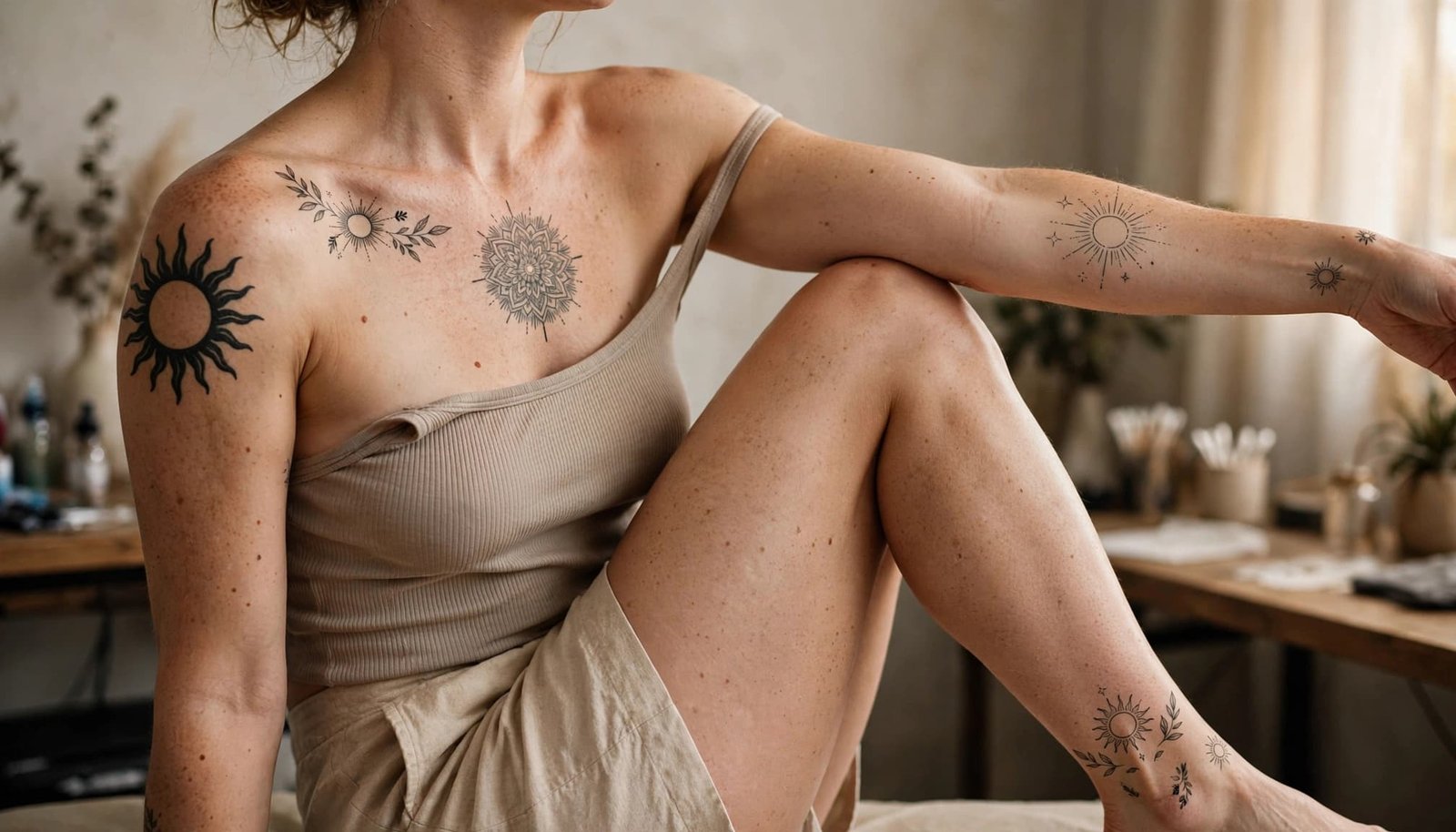
Best Small and Discreet Placements for Simple Sun Ideas
Tiny sun tattoos suit areas where a simple outline can stand on its own. The wrist offers easy visibility and works well for a small circle, short rays, or a sunrise. However, watchbands, sleeves, frequent hand movement, and regular sunlight can affect this area over time.
A finger tattoo is even more discreet, but it receives constant use. Washing, gripping, rubbing, and hand sanitizer can cause finger ink to fade or soften faster than ink on less active areas. Choose a very simple design and expect that a touch-up may eventually be needed.
The ankle can hold a tiny sun near the ankle bone or slightly above it. Shoes and socks may rub the area, especially during the healing stage. A foot tattoo is attractive for a private design, yet footwear, sweating, walking, and sun exposure can make healing less comfortable and may shorten the crisp appearance of delicate lines.
Behind the ear and at the back of the neck offer a more hidden quality. These spots suit tiny outlines, short rays, and small celestial symbols. Hair, collars, and hair products can create friction, so placement should account for your daily routine. The collarbone gives a fine-line sun an elegant, visible frame, although straps and sun exposure may affect a fresh tattoo.
| Placement | Best for | Main consideration |
|---|---|---|
| Wrist | Tiny outlines and simple rays | Watches, sleeves, and sun exposure |
| Finger | Very small symbols | High use and faster fading |
| Ankle | Small suns and half-suns | Socks, shoes, and friction |
| Foot | Private minimalist designs | Walking and footwear |
| Behind the ear | Hidden outline tattoos | Hair and collar friction |
| Back of neck | Small vertical or centered suns | Collars and sun exposure |
| Collarbone | Delicate, graceful designs | Straps and visible sunlight |
Best Medium and Large Placements for Detailed Sun Tattoos
Medium and large designs need enough skin for the rays, center, shading, and surrounding details to remain separate. The forearm works well for vertical sunbursts, landscapes, and bold traditional designs. It is easy to show or cover, although the outer forearm receives regular sunlight.
The upper arm and shoulder offer muscle and structure that can support a circular design. A shoulder sun can follow the rounded cap of the muscle, while an upper-arm piece can connect with flowers, moons, clouds, or an existing sleeve. Because the shoulder curves, a perfect circle may look slightly different as the body moves. Your artist should position the stencil while your arm rests naturally.
The shin and calf provide length for a sun over mountains, waves, or a narrow celestial scene. The shin has less padding and sits close to bone, so many people find it more intense than the calf. A calf tattoo usually has more visual softness because the area offers additional muscle.
For a larger and more private design, the thigh gives generous space for mandalas, realistic sunsets, and colorful compositions. The ribs and stomach can accommodate wide scenes, but body movement and skin sensitivity make stencil placement especially important. Clothing may also rub against a healing tattoo in these areas.
The chest and sternum feel visually central because they sit near the heart and the body’s natural centerline. A symmetrical sun across the chest can look protective and strong, while a sternum sun can create a jewel-like focal point. These areas may feel more intense during tattooing because of bone, thin skin, and sensitivity.
The upper back and shoulder blade provide broad surfaces for mandalas, tribal-inspired designs, large blackwork suns, or scenes with several layers. The back also offers privacy beneath most clothing. Curved surfaces still matter, so ask your artist to check the design from standing, sitting, and relaxed positions.
A detailed sun tattoo needs breathing room. When rays, lettering, flowers, and shading compete for the same small space, the design can lose its clarity.
Pain, Size, Visibility, and Choosing a Skilled Tattoo Artist
Pain varies with your body, the artist’s technique, the session length, and your personal sensitivity. Wrist, ankle, ribs, chest, sternum, neck, shin, and other bony areas may feel sharper than the upper arm, thigh, or calf. Plan for breaks, eat beforehand, drink water, and tell the artist if you need to pause.
Size affects both detail and long-term readability. A tiny sun may only support an outline and a few rays, while a larger tattoo can hold faces, dotwork, lettering, flowers, constellations, or landscape layers. Fine lines and tightly packed details may soften with age, especially in high-friction areas, so your artist may recommend a slightly larger design or stronger line weight.
Visibility also deserves an honest look. A forearm, wrist, hand, neck, or collarbone tattoo may affect workplace expectations or formal clothing. Upper-arm, thigh, rib, and back placements are easier to cover. Consider your current job, future plans, uniforms, and comfort with strangers seeing the tattoo.
Review an artist’s healed work, not only fresh photographs. Look for clean circles, even rays, smooth color, and linework that remains readable after healing. Ask how the studio handles single-use needles, ink caps, gloves, surface cleaning, and written aftercare. Also check local licensing or registration requirements.
Choose an artist whose portfolio matches your intended style. A specialist in fine-line work may not be the right person for a large traditional sun, and a realism artist may approach geometric symmetry differently. If your design uses a sacred, mythic, or culturally specific reference, discuss it with the artist and research the history independently. A symbol should never be copied simply because it looks attractive.
How to Personalize the Design Before Your Appointment
Start with the feeling you want the tattoo to carry. Should the sun feel soft and healing, bright and joyful, fierce and protective, or calm and spiritual? That emotional tone will guide the shape, line weight, color, and placement.
Next, choose the main form. You might prefer an open circle, a half-sun, a face, a black disk, a mandala, or a sun rising behind a landscape. Decide whether color or linework leads. Warm yellow and orange create a lively image, while blackwork, dotwork, and negative space create stronger graphic contrast.
Add only one or two meaningful details at first. A birth flower, date, constellation, handwritten word, family symbol, mountain range, or small animal can carry more personal meaning than a crowded collection of images. If you want lettering, bring a clear sample of the handwriting and discuss how it may change at the chosen size.
Bring several references that show the mood, composition, and line style you like. Avoid asking an artist to copy one image exactly. Instead, explain what attracts you to each reference and ask for an original composition that fits your body.
Before booking, print the proposed design at its actual size. Tape it to the placement for a full day, then check it in a mirror, under clothing, and while moving. This simple test can reveal whether the sun feels too small, too visible, too centered, or too close to another tattoo.
Sun Tattoo Aftercare and Long-Term Protection
Your artist’s instructions take priority because bandage types, ink saturation, placement, and skin response can differ. Keep healing film or bandages on for the period your professional recommends, then wash your hands before touching the tattoo.
Use lukewarm water and mild, fragrance-free soap. Wash gently without scrubbing, pat the area dry with a clean towel, and apply only a thin layer of the recommended moisturizer. Don’t pick scabs or scratch peeling skin. Peeling often occurs during the first week and can be part of normal healing.
While the tattoo heals, avoid pools, hot tubs, baths, saunas, heavy friction, tight clothing, and direct sun. Freshly tattooed skin should not receive sunscreen until it has fully healed. For additional guidance, Mayo Clinic’s tattoo safety information explains infection risks linked to contaminated equipment and poor sterilization.
Once the skin has closed and healed, protect your sun tattoo with broad-spectrum sunscreen, ideally SPF 30 or higher, whenever it will be exposed. Regular moisturizing can also help the skin maintain a smooth appearance. Contact a medical professional if redness spreads, pain worsens, swelling increases, pus or foul drainage appears, red streaks develop, or you experience fever, chills, or an unusual reaction.
Conclusion
A sun tattoo can be tiny and private, bold and radiant, or part of a larger story filled with flowers, moons, mountains, and personal symbols. The strongest design is one whose meaning and style still feel true years from now.
Choose a size that suits the placement, work with a skilled artist, and protect the finished tattoo after it heals. Save your favorite sun tattoo ideas, then combine the details that speak to you into an original design that feels entirely your own.
Save the pin for later


- 80 Moon Tattoo Ideas for Women, With Meanings and Placements - September 9, 2026
- 50 Wildflower Tattoo Ideas for a Feminine Look - September 9, 2026
- 100 Gorgeous Sun Tattoo Ideas for Every Style - September 9, 2026
Leave a Reply