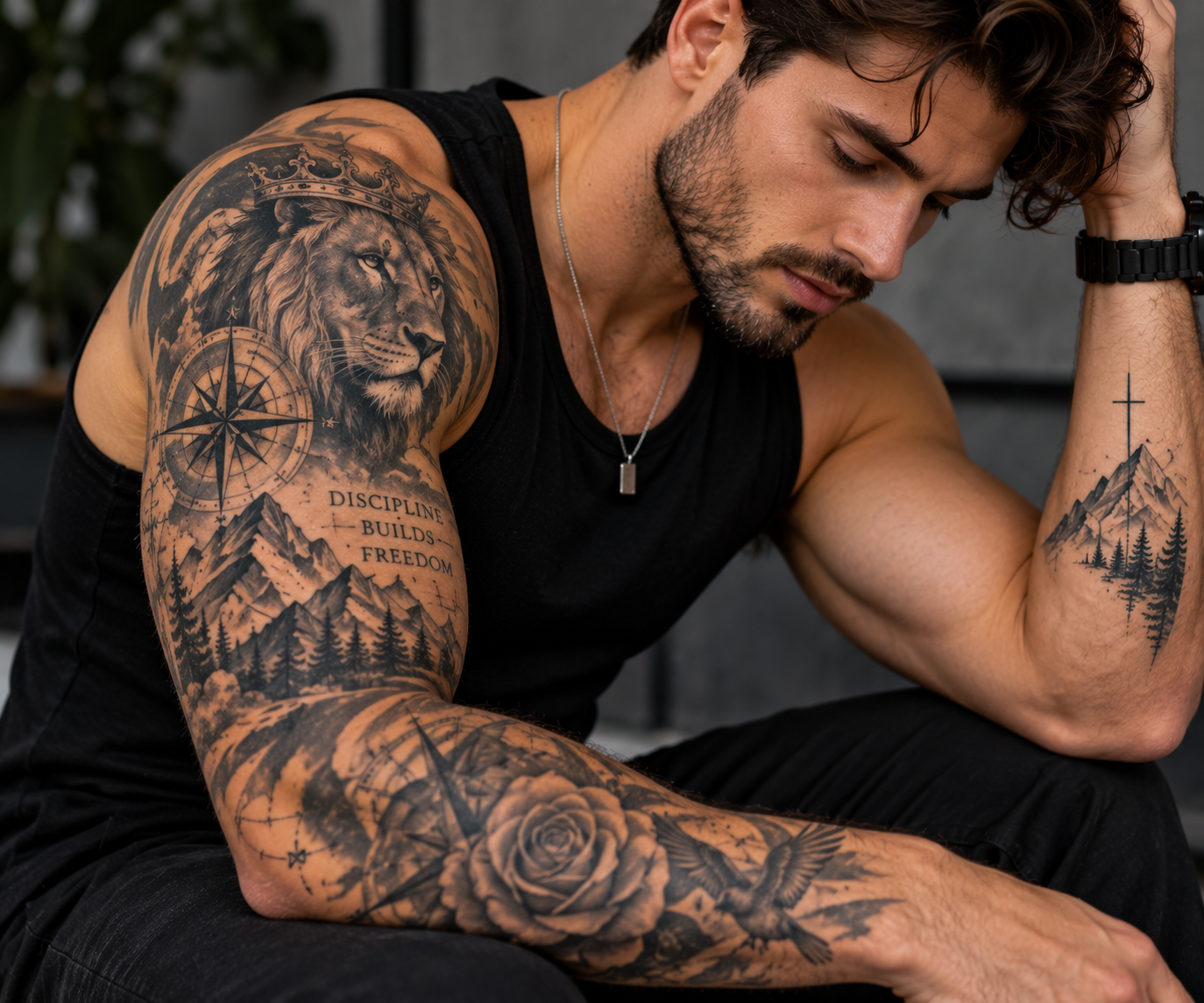
Modern Tattoo Drawings for Men: Geometric, Fine Line, and Blackwork Ideas
A tattoo used to be a bold declaration splashed across your arm in full color. Today, the most striking designs for men are often the quietest ones: clean geometric shapes, fine line work, and bold blackwork that looks more like architecture than art.
That’s the appeal of modern tattoo drawings. They age well, they sit comfortably under a dress shirt or a rolled-up sleeve, and they work whether it’s your first piece or your fifteenth. The problem is knowing which style fits you, and which ideas are worth taking to your artist.
That’s exactly what you’ll find below: standout designs across geometric, fine line, and blackwork styles, plus practical guidance on placement and picking what suits you.
What Makes a Tattoo Design Modern and Masculine?
Modern masculine tattoos share a few core traits: clean lines, deliberate composition, and restraint. Think architecture rather than decoration. A geometric sleeve fragment or a single fine line drawing reads as confident because it doesn’t shout. The style favors structure, negative space, and black ink over busy color palettes, which is why these designs tend to age gracefully on the skin.
If you’re weighing styles for your next piece, the comparisons in this men’s style and grooming guide break down how different aesthetics suit different personalities.
Modern Tattoo Drawing Styles That Fit Men Perfectly
Three styles dominate the current scene for men, and each one has a distinct personality. Geometric work leans structured and architectural, fine line stays quiet and understated, and blackwork goes bold with pure saturation. Here’s how each one actually looks on skin, and who it suits best.
Geometric Lines: Bold, Clean, and Simple Designs
Geometric tattoos are built from shapes: circles, triangles, hexagons, and repeating patterns arranged with mathematical precision. The style traces back to sacred geometry used in ancient temples and Islamic tilework, and artists like Dr. Woo helped push it into mainstream tattoo culture. On the arm or chest, a well-placed geometric piece looks more like blue ink engineering than decoration. If you want inspiration for structured designs, these geometric tattoo ideas for men cover everything from minimal single shapes to full patterned sleeves.
Fine Line Art: Sharp Ideas for Subtle Ink
Fine line tattoos use single-needle work to create thin, delicate strokes that almost look drawn with a pen. Old school tattoos demanded thick outlines and heavy shading; fine line flipped that formula entirely. The result is ink that reads as subtle from a distance but reveals sharp detail up close: a tiny mountain range on the forearm, a portrait outline on the bicep, a coordinate script on the ribs. These designs suit men who want meaning without a billboard. For more understated options, browse these small tattoo ideas for men that work well in discreet placements.
Abstract and Blackwork Art: Freedom of Expression
Blackwork covers the boldest end of the spectrum: solid black ink, heavy tribal-inspired patterns, and abstract shapes that flow with the body’s natural lines. The real advantage is freedom. A single drawing can merge a wolf silhouette with geometric fractals, or blend brushstroke textures into hard-edged linework, all in one composition. Nothing needs to match or obey a rule. For men who want a piece that can’t be replicated, these abstract tattoo design ideas show how mixed concepts come together on one canvas. Blackwork also ages the best of the three, since dense black holds its shape for decades.
Choosing the Right Placement for Your Modern Tattoo
A great design on the wrong body part falls flat. Placement changes everything: how the drawing flows, how it ages, and how often you actually see it. A geometric mandala that looks sharp on a flat forearm can warp awkwardly around a shoulder curve. Before you commit ink to skin, think about where the piece will live and how your body moves under it.
Matching the Design to Each Body Part
The forearm is the most forgiving canvas. Its surface stays relatively flat and visible, which suits geometric bands, fine line script, and vertical designs like a dagger or mountain range. Because the arm tapers, ask your artist to orient lines along the limb rather than across it.
The chest rewards larger, symmetrical pieces. Pectoral geometry, a centered sternum design, or a blackwork fragment spreading from the shoulder all work here. Chest skin stretches with weight changes, so bold, simple shapes hold up better than intricate detail.
The back offers the most space and the least day-to-day visibility. Full compositions, sprawling abstract work, and spine-centered fine line designs fit naturally. Legs, meanwhile, suit vertical flow: calf bands, thigh panels, and patterns that wrap the shin. If you want more ideas for statement pieces, these tattoo ideas for men cover a range of placements and styles.
How Placement Changes the Final Look
Two factors shape the result: curvature and light. Round areas like shoulders and calves distort straight lines, so skilled artists bend patterns to follow the muscle instead of fighting it. Flat zones, like the inner forearm and outer thigh, keep precision linework crisp.
Visibility matters too. Ribs and inner arm placements sit softer in shadow and fade slightly faster due to friction. Hands and forearms stay on display daily. Decide honestly whether you want the tattoo as a private piece or a public one, then place it accordingly. A design that fits its spot looks intentional; one that fights it looks like a sticker.
How to Pick a Drawing That Fits Your Style and Body
Scrolling through hundreds of tattoo drawings is easy. Choosing the one you’ll wear for the rest of your life is harder. The trick is to filter every option through three questions: does it match who you are, does it suit your body, and does it work at the size you want?
Match the Drawing to Your Personality and Daily Life
A tattoo should feel like yours, not like something you copied off a Pinterest board. Start with what actually matters to you: travel, family, music, engineering, the outdoors. A fine line mountain range makes sense for a hiker. A precise geometric pattern suits someone who loves order and design. Abstract blackwork fits a man who’d rather make a statement than explain one.
Daily life matters just as much. If you work in a conservative office, a small piece on the upper arm or ribs gives you flexibility. If you’re self-employed or work outdoors, you have free rein. Be honest about dress codes and family reactions before you commit.
- Write down three things you want the tattoo to say about you.
- Pick a drawing that expresses one of them without you having to explain it.
- Rule out anything you’d feel the need to hide every single day.
Consider How Size Changes the Design
Some drawings only work at certain sizes. A highly detailed blackwork panel loses its impact when shrunk to two inches, because the fine details blur together over time. On the other hand, a simple single-shape geometric design looks awkward blown up across a whole back; it reads as empty.
Fine line work needs enough size to survive aging, since thin strokes can soften and spread slightly over decades. As a general rule, the more detail in the drawing, the more space it needs. Bring this up with your artist early, because they’ll often redesign a drawing to fit your chosen placement properly.
Test Before You Commit
Never skip the test run. Print the drawing at actual size, tape it to the placement, and wear it around for a week. Look in the mirror from different angles, with sleeves up and down. If the piece still feels right after seven days of real life, you’ve found your drawing. If you stop noticing it, or it starts to bother you, keep looking. Patience here is the cheapest insurance in tattooing.
What to Expect: Cost, Pain, and Aftercare Basics
Budget and healing matter as much as design. A modern tattoo is an investment in something you’ll wear for decades, so going in with realistic numbers keeps the experience smooth instead of stressful.
What You’ll Actually Pay
Most US shops charge between $100 and $250 per hour, with a minimum session fee around $80 to $150. Small fine line pieces often fit inside that minimum, while a full blackwork sleeve can run into the thousands over multiple sittings. Price usually reflects the artist’s experience and demand, not just shop overhead. Book a skilled artist even if it means saving longer; a cheap tattoo is expensive to fix.
Pain Levels and Healing Timeline
Pain depends heavily on placement. Forearms and outer thighs feel manageable, while ribs, spine, and inner arm sting more. Most men describe it as a hot scratch rather than sharp pain, and sessions under two hours stay comfortable for beginners.
Healing follows a predictable rhythm: surface healing takes two to three weeks, and deeper layers settle over one to two months. Expect light flaking and itching around day five, which is normal. Keep it clean, moisturize with unscented lotion, skip the gym for a few days, and stay out of pools and direct sun.
One rule makes or breaks your final result: never pick at the flakes. Doing so pulls ink out and leaves patchy spots.
If you’re still finalizing your design, revisit the geometric tattoo ideas for men covered earlier, pick your drawing, and book a consultation this week. Your future ink starts with one conversation.
Conclusion
Modern tattoo drawings earn their popularity for good reason. They’re clean, deliberate, and built to age well, whether you go geometric, fine line, or full blackwork. Each style carries its own personality, so there’s a fit for almost any man and any story.
Placement and aftercare decide how that story holds up. Match the design to the right body part, size it correctly, and follow the healing rules, especially the no-picking rule, and your ink will look sharp for decades.
Start browsing drawings today and shortlist a few that feel like you. Then book a consultation with a reputable artist and turn the sketch on your screen into ink on your skin.
Save pin for later


- 21 Subtle Minimalist Tattoo Ideas That Age Gracefully - September 27, 2026
- Blackwork Tattoo Ideas for Men: Designs, Placement, and Planning - September 26, 2026
- 20 Tattoo Designs and Where to Place Them for the Best Fit - September 26, 2026
Leave a Reply