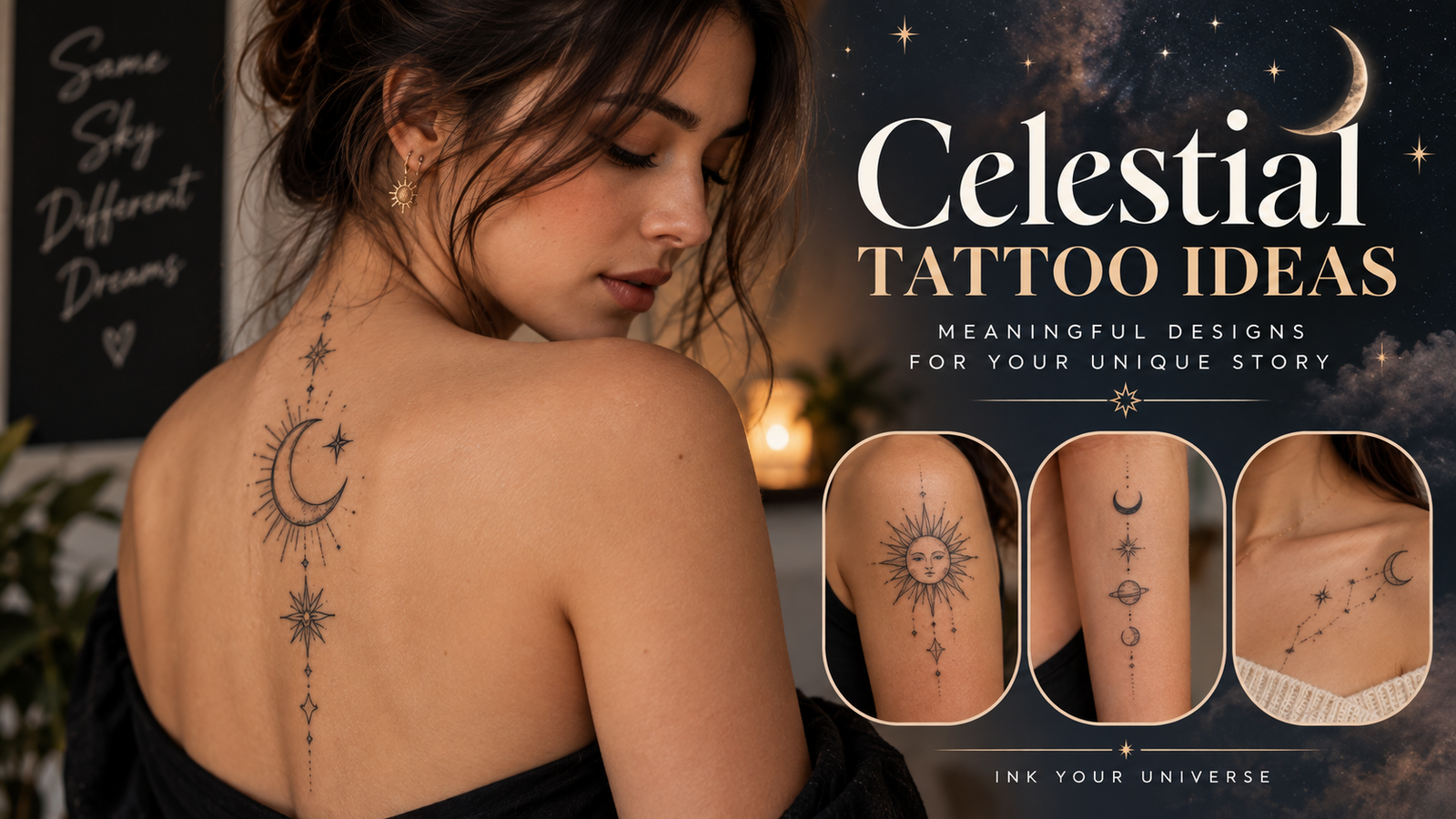
Celestial Skin Art: Design Ideas and Placement for Your Ethereal Look
Star and moon tattoos have quietly become one of the most requested designs of 2026, and it’s easy to see why. Walk into any studio right now and you’ll find flash sheets covered in constellations, crescent moons, suns, and zodiac symbols waiting to be claimed.
That’s what celestial skin art is at its core: tattoos built from the imagery of the night sky, used to give your look a dreamy, otherworldly edge. Unlike a trend that fades with the season, these designs carry personal meaning, whether that’s your birth chart, a constellation tied to someone you love, or simply an affinity for everything cosmic.
But there’s a gap between wanting an ethereal tattoo and getting one you’ll love in ten years. Placement changes everything with these designs, and the fine-line style most celestial art depends on requires an artist who knows what they’re doing.
Below, we’ll walk through the best design ideas, where each one sits best on the body, the styles worth considering, what you can expect to pay and feel in the chair, and how to care for your ink once it’s done. Consider this your map before you commit to the sky.
What Celestial Skin Art Really Means (and Why It’s Trending)
Celestial skin art pulls its imagery straight from the night sky. Moons, suns, stars, and constellations have decorated human skin for centuries, but the modern versions trade heavy, symbolic boldness for something softer and more personal. Each element carries its own meaning, which is part of why these designs age so well emotionally.
The Symbols Behind the Stars: Moon, Sun, and Constellation Meanings
The crescent moon is the most requested piece, and it stands for growth, intuition, and change. Because it waxes and wanes, many people use it to mark a period of transformation in their lives.
Suns sit at the opposite end of that cycle. They represent energy, renewal, and clarity, so a sun tattoo often signals a fresh start or a love of the light after a hard season.
Stars are simpler and quieter. A single star usually means guidance, a nod to sailors who steered by the sky. Clusters of small stars suggest people or hopes you follow.
Constellations take the meaning further. Orion, Cassiopeia, and other recognizable patterns are frequently inked to match a birth date or an anniversary, which makes the design both universal and deeply private. A constellation is only visible to those who know where to look, and that’s exactly the appeal.
How the Ethereal Aesthetic Shapes Tattoo Design Today
The celestial trend is really a branch of the broader ethereal aesthetic: soft, dreamy, and slightly otherworldly. On skin, that translates to fine line work, delicate shading, and gentle gradients instead of heavy black outlines.
Styles like hand-poked and single-needle work suit this look because they produce thin lines that heal lighter. Social media has pushed this shift hard; minimalist cosmic designs now dominate tattoo hashtags, while the bold tribal styles of the early 2000s have mostly faded from flash sheets. Smaller, softer pieces also fit placement trends like the wrist, collarbone, and behind the ear.
If you want to see how placement interacts with these styles, the next section breaks down where each design sits best on the body.
Celestial Tattoo Ideas to Claim and Elevate Your Ethereal Look
Now for the fun part: the designs themselves. Celestial art scales beautifully, which means the same sky imagery can live in a two-centimeter moon behind your ear or stretch across an entire sleeve. The trick is matching the size and detail level to both your body and your commitment. Below are the ideas worth screenshotting, sorted from the most personal to the smallest to the boldest.
Your Birth Chart as a Tattoo: Zodiac Signs and Star Maps
The most personal celestial tattoo you can get is the sky on a date that mattered to you. Custom star map tattoos plot the exact positions of stars and planets at a specific moment, such as a wedding night, a child’s birth, or the day you moved across the country. Artists typically generate the chart from your date, time, and location, then adapt it into fine-line linework. Tools like the chart generators on sites such as The Pattern or dedicated star map services give you a starting reference to bring into the studio.
Zodiac glyphs work as a quieter alternative. A single symbol like Aquarius’s wavy lines or Scorpio’s curved arrow sits small enough for a wrist or ankle. Pairing a glyph with its actual constellation, drawn as connected dots, adds depth without clutter. Planet alignment designs, which show the current planetary configuration in a vertical or circular arrangement, suit people who want something astrological but less tied to a sun sign. These charts reward an artist who understands dotwork, because stars rendered as tiny points of ink read far better than solid dots.
Minimalist Options: Tiny Stars, Crescent Moons, and Sparkle Clusters
If this is your first tattoo, small is the smart entry point. The most popular micro designs include a single fine-line star tucked behind the ear, a three-dot sparkle cluster along the collarbone, and a micro crescent moon on the side of a finger. Each one takes under 30 minutes in the chair, and most cost between $50 and $150 at standard shop minimums.
These pieces suit almost anyone because they hide easily under clothing and heal fast. One tip: keep the design to two or three elements. Tiny tattoos blur with age if the linework gets too dense, so a good artist will slightly thicken a micro moon’s lines so it stays legible in ten years.
Statement Pieces: Galaxy Sleeves, Nebula Backs, and Cosmic Wraps
At the other end sit full-commitment pieces. A galaxy sleeve blends purples, blues, and blacks with white star speckles layered over nebula clouds, usually wrapping from shoulder to wrist. Nebula back pieces work the same way on a larger canvas, letting color gradients flow across the shoulder blades. Ribcage constellation wraps and celestial ankle bands, where a thin cosmic band circles the limb, offer boldness with less surface area.
These designs need multiple sessions, often three or more for a full sleeve, and they demand an artist with strong color-packing skills. Color blends like these bruise easily if rushed, so ask to see healed photos of previous space work before you book. Who they suit: anyone ready to invest real time and budget in a tattoo that turns an entire limb into a night sky.
Choosing the Right Placement for Your Celestial Design
A celestial tattoo lives or dies by its placement. The same crescent moon that looks elegant on a collarbone can disappear into the curve of a shoulder blade, and a constellation needs the right stretch of skin to actually resemble the night sky. Before you fall in love with a design, think about three things: how visible you want it, how it follows your body’s natural lines, and how much discomfort you’re willing to sit through.
Placement Meets Pain: What to Expect in Sensitive Spots
Let’s be honest about the pain first, because it should factor into your decision. Ribs, spine, and collarbone sit at the top of the discomfort scale. Thin skin over bone means the needle works close to nerve endings, so expect a sharp, buzzy sensation rather than a dull ache. A spine tattoo is especially demanding since sessions along the vertebrae tend to feel more intense the longer they run.
Forearms, outer thighs, and shoulders are far gentler. These spots carry more muscle and fat between skin and bone, so most people describe the feeling as tolerable scratching. Ankles fall somewhere in the middle; the bony parts sting, but a small design is over quickly.
The good news is that most celestial designs are small and fine-line, which keeps sessions short. A micro moon behind the ear might take fifteen minutes, even if that spot is tender.
Placement also shapes how the design reads. Constellations trace beautifully along the spine, each star aligning with a vertebra for a look that’s striking when your back is bare. A moon phase band wraps naturally around the forearm or upper arm, following the limb like a bracelet. Collarbone placements suit horizontal elements, while shoulder blades give rounder designs like full moons room to breathe. Wrist and ankle spots favor slim vertical pieces, and they’re easy to hide under a watch or sock when work calls for it.
Match the spot to your daily life. If your workplace bans visible ink, choose somewhere coverable. If you want a daily reminder, the inner wrist wins every time.
Styles, Costs, and Finding the Right Artist
Once you know what you want and where it goes, the remaining decisions come down to execution. Style choice shapes how your tattoo ages, budget expectations shape how many sessions you book, and your artist choice shapes everything. Here’s the practical side of the decision.
Fine Line vs. Realistic Galaxy Work: Which Style Fits Your Vision?
Fine line work uses single needles or tight three-round liners to create thin, delicate strokes. It’s the natural fit for constellation dots, tiny moons, and zodiac glyphs. The tradeoff is that fine lines heal lighter and fade faster than bolder work, so expect a touch-up within the first few years, especially on spots that get sun or friction. Done well, though, a fine-line piece settles into skin gracefully and keeps its elegance.
Realistic galaxy work sits at the opposite end. Full-color nebulas rely on packed gradients of purple, blue, and teal layered under white star highlights. These pieces look stunning fresh, but color tattoos generally need more maintenance than black ink, and the soft blends can blur over a decade. Watercolor-style cosmic pieces blur even faster since they skip solid outlines. Stippling and blackwork offer middle grounds: dotwork holds its texture longer than watercolor, while heavy black linework outlasts everything on the shelf.
If you want a piece that looks identical in fifteen years, lean toward blackwork or stippled designs. If you want the dreamy, painterly look and accept occasional touch-ups, realism earns its place.
What a Celestial Tattoo Really Costs
Pricing starts with the shop minimum, which runs $80 to $150 at most US studios and covers setup and sterilization even for a fifteen-minute moon. A small fine-line piece typically lands between $100 and $250, while large custom work is billed hourly at $150 to $250 per hour depending on the city and the artist’s experience. A galaxy sleeve usually needs three or more full sessions, so budget $1,500 to $4,000 for a serious color piece and $500 to $900 for a half-day nebula section.
Rates vary a lot by region. The same collarbone constellation might cost $120 in a smaller Midwest city and $300 in Brooklyn or Los Angeles. Highly sought artists also charge deposits, often $50 to $200, applied toward the final total.
Vetting matters more than price. Scroll a candidate’s portfolio looking for healed photos, not just fresh shots, since healed work shows how their lines and color actually settle. For cosmic work specifically, check that their gradients stay smooth and their star speckles stay crisp. Many studios showcase artist portfolios on their booking pages, so compare a few before committing. A cheaper rate from someone who has never packed nebula color costs more in cover-ups later.
Aftercare and Keeping Your Cosmic Ink Bright
Your tattoo isn’t finished when the needle stops; it’s finished when it heals. The first two to four weeks decide how crisp your constellations stay and how smooth your nebula gradients settle, so treat aftercare as part of the design process, not an afterthought.
Healing and Washing: The First Few Weeks
Expect the surface to heal in about 2 to 4 weeks, with deeper layers taking up to two months. For the first few days, your artist will wrap the piece, either with a film like Saniderm or a standard bandage. Follow their instructions on when to remove it, then start a simple washing routine.
Wash the tattoo twice a day with lukewarm water and fragrance-free antibacterial soap. Use clean fingertips, never a washcloth, and pat dry with a paper towel. Afterward, apply a thin layer of unscented moisturizer such as Aquaphor for the first few days, then switch to a light lotion. Keep the film thin; the skin needs air to heal properly.
A few rules that matter more than they sound:
- Don’t soak the tattoo. Showers are fine, but skip baths, pools, and hot tubs for at least three weeks.
- Don’t scratch or pick. Light flaking and itching are normal; pulling scabs off pulls ink out with them.
- Wear loose clothing over the area. Friction on fresh ink blurs fine lines fast.
Sun Protection: Why Galaxy Colors Fade First
Sunlight is the biggest threat to your tattoo, and it stays a threat long after healing ends. UV rays break down pigment particles in the skin, which is why a decade-old tattoo left unprotected looks gray and soft-edged. Once your piece is fully healed, apply a broad-spectrum SPF 30 or higher whenever the tattoo sees daylight, and reapply after swimming or sweating.
White and pastel inks deserve extra caution. The pigments in galaxy pieces, the white star speckles and the lavender and teal nebula clouds, are made of larger particles and lighter tones that fade noticeably faster than dense black linework. A nebula that loses its highlights turns muddy, so many artists recommend SPF 50 on color-heavy pieces and keeping large color work covered during long sun exposure.
Touch-Ups Keep the Sky Sharp
Even with perfect care, fine lines soften and light pigments dull over time. Plan on a touch-up within the first few years, and budget for it the way you budgeted the original piece. A quick session to re-crisp a crescent moon or refresh star speckles costs a fraction of the initial tattoo and keeps your slice of the sky looking freshly inked.
Conclusion
Celestial skin art works best when it means something. A crescent moon borrowed from a trending flash sheet will always feel less yours than a constellation tied to a real date, a person, or a turning point in your life. Pick the symbol first, then build the design around it.
The path from idea to inked skin comes down to five steps: choose a design with personal weight, match it to a placement that fits your body and daily routine, settle on a style your budget can maintain, vet an artist through healed photos, and commit to the aftercare that keeps it sharp. Skip any one of those and the piece suffers; follow all five and you get a tattoo that holds up for decades.
Your ethereal look isn’t a trend to chase, it’s a story already written on your skin’s calendar, waiting to be claimed. Book the consultation, bring your star chart, and make the sky yours.
Save pin for later


- Skull Tattoo Designs for Men That Stay Bold Over Time - September 25, 2026
- 30 Tips to Find Your Perfect Tattoo Style and Artist - September 25, 2026
- Saniderm Healing: Wear Time, Fluid, and Aftercare - September 25, 2026
Leave a Reply