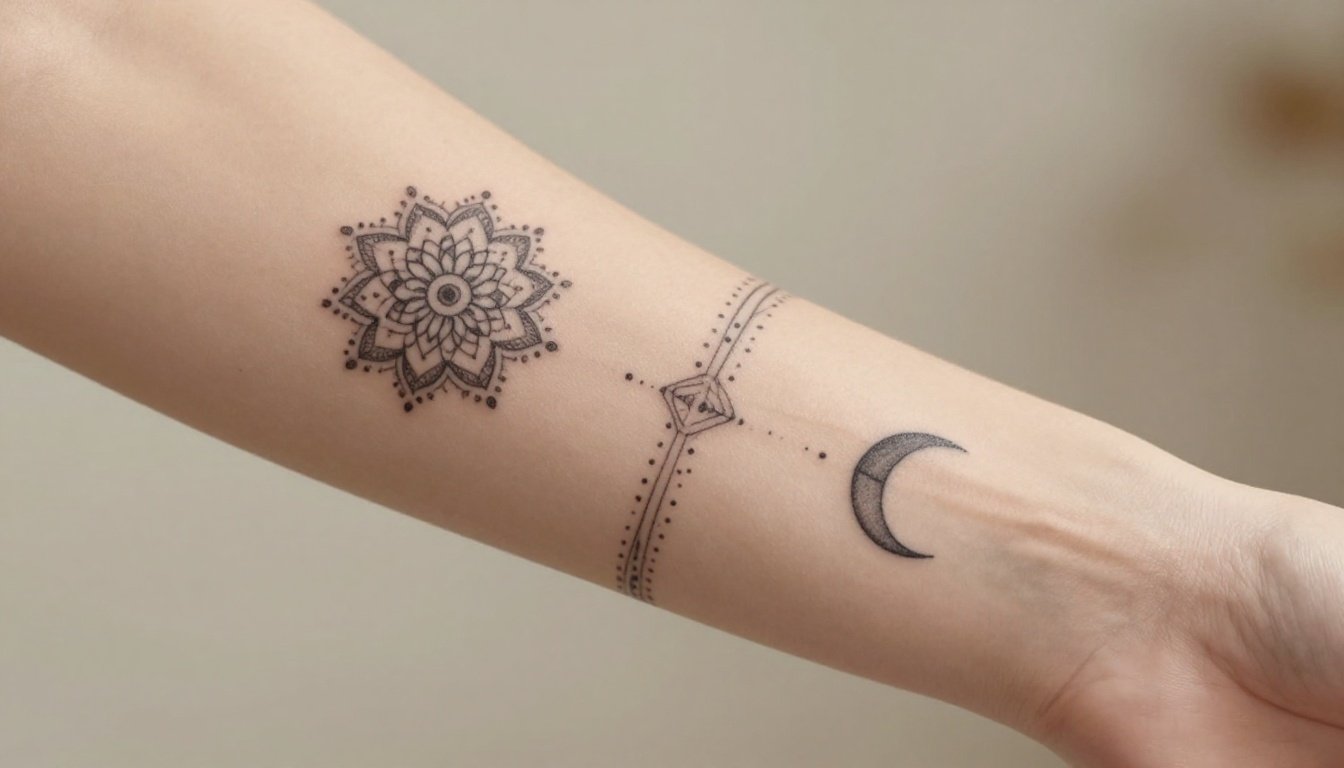
30 Small Ornamental Forearm Tattoo Ideas for Every Style
If you’re searching for small ornamental tattoo forearm ideas, you probably want something decorative without taking over your arm. Ornamental tattoos use symmetry, repeating shapes, fine lines, dots, lace-like details, and decorative geometry to create designs that feel like jewelry on the skin. For more ways to connect placement with personal meaning, browse these meaningful forearm tattoo inspiration.
The forearm works well because it offers a long, visible surface for vertical, diagonal, or wrapping artwork. That space gives a small design room to follow the arm’s shape, whether you prefer a simple cuff, a centered mandala, a floral ornament, or a celestial motif.
Small tattoos still need thoughtful planning. Clear spacing helps separate fine details as the tattoo heals, and your artist may recommend slightly stronger outlines than an ultra-fine design so the pattern stays readable over time. Orientation matters too, since the forearm rotates and the tattoo can face you, other people, or both.
The 30 ideas below include delicate bands, symmetrical symbols, floral details, mandalas, and jewelry-inspired ornaments, with practical notes to help you choose a design that fits your style and placement.
30 Small Ornamental Forearm Tattoo Ideas for Every Style
The strongest small ornamental tattoos use one clear focal shape, open negative space, and enough room between lines. Designs under 2 inches should stay simple, while many forearm pieces look clearer around 2 to 4 inches.
Simple ornamental cuffs and bands for a clean look
- Thin lace cuff. A narrow lace pattern can wrap around the forearm or sit horizontally; personalize it with scalloped edges.
- Bead-chain band. Small linked circles create a jewelry-like strip around the arm; add one distinct center bead.
- Repeating triangle band. Inverted triangles form a crisp geometric border; leave open gaps so each shape heals clearly.
- Dotted armband. Two fine lines with evenly spaced dots create a restrained cuff; vary the dot sizes for a softer finish.
- Small geometric half-cuff. A partial band curves across one side of the forearm; add a diamond or hexagon at its center.
- Negative-space ornamental band. Bold outer lines frame untouched skin instead of filling the entire band. A partial band can fit a changing forearm more easily than a perfect circle.
Open spacing matters because crowded fine lines can merge as the tattoo heals.
Small mandalas and geometric ornaments with balanced detail
- Mini mandala medallion. A round outer border surrounds petals and dots; place it on the outer forearm for easy viewing.
- Four-point geometric star. A sharp diamond-like star suits a horizontal or diagonal orientation; personalize it with tiny surrounding dots.
- Hexagon flower. Six outer sides frame a simple petal center; place it vertically and add one small leaf.
- Sunburst ornament. Short rays extend around a solid center circle; use alternating long and short rays for contrast.
- Diamond-shaped filigree piece. Curved lines fill a pointed diamond; position it lengthwise and replace the center with your favorite symbol.
- Stacked geometric charm. Three small shapes sit one beneath another; combine a circle, triangle, and diamond in a vertical layout.
Strong outlines should form the structure, while the finest dots and lines stay inside it. Choose the outer forearm when visibility matters, or the inner forearm for a more private design.
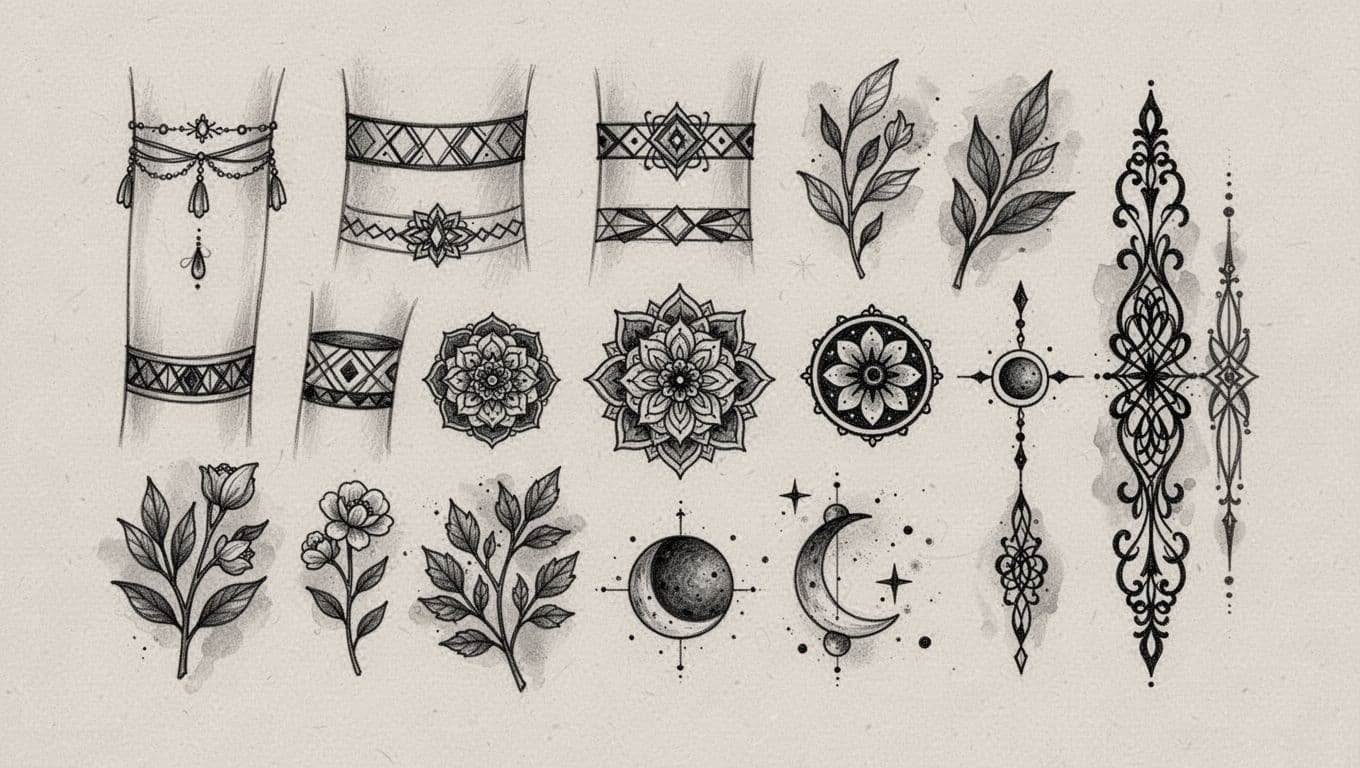
Floral and botanical ornaments that feel soft and timeless
- Ornamental rosebud. A compact bud with curved leaves creates a decorative vertical piece; add dots around the petals.
- Small lotus medallion. Layered petals fit inside a circular frame; place it across the forearm and personalize the center.
- Fern and bead chain. A slim fern stem runs beside linked dots; let the stem follow the arm’s natural length.
- Symmetrical wildflower. Two matching stems frame a simple flower head; choose a favorite petal shape rather than realistic shading.
- Floral lace drop. A small flower hangs beneath a lace-like border; place it near the wrist with the drop facing the hand.
- Tiny vine frame. Curved vines create an open oval around a small bloom; add berries or dots for contrast.
Black ink keeps these ornaments crisp, while black-and-gray adds gentle depth. Pale gray alone may fade and lose clarity, so discuss contrast with your artist. The American Academy of Dermatology’s tattoo care guidance also recommends protecting healed tattooed skin from sun exposure.
Celestial, symbolic, and jewelry-inspired forearm designs
- Crescent moon with beadwork. Place bead-like dots along the moon’s curve and angle it diagonally; add a tiny star inside.
- Sun and star charm. Pair a small sun with one star in a horizontal layout; personalize the rays with rounded or pointed ends.
- Ornamental eye. Frame a simple eye with curved filigree; keep the pupil bold enough to read from a short distance.
- Small compass medallion. A circular border surrounds four strong points; angle it diagonally and add dots between directions.
- Keyhole filigree. Combine a round keyhole with a tapered ornamental base; place it vertically near the inner forearm.
- Pendant-style symbol. Suspend a simple heart, moon, or abstract emblem from a short chain; keep the design vertical.
These symbols can carry personal meaning without requiring a fixed interpretation. Keep small focal details bold, especially when the tattoo must remain legible at a glance.
Delicate vertical and wraparound designs for narrow forearms
- Vertical lace drop. A narrow top motif flows into a scalloped lower edge; place the larger detail toward the upper forearm.
- Symmetrical ornamental arrow. Curved filigree surrounds a central arrowhead; align it with the forearm’s length.
- Chain of three charms. Three different symbols descend in a balanced line; use initials, stars, or geometric shapes.
- Narrow filigree spine. A central line carries small mirrored curls; leave generous skin between each detail.
- Wrist-to-mid-forearm vine ornament. A slim vine travels upward with two leaves and one flower; use black ink for lasting definition.
- Mirrored side-panel design. Matching ornaments sit along both sides of the forearm rather than crossing its center; connect them to a future cuff or larger composition.
Vertical layouts follow the arm’s natural length instead of competing with it. Place larger focal elements toward the wider upper forearm and smaller details near the wrist, leaving room to expand the design later.
How to Choose the Right Ornamental Forearm Design and Placement
Choosing from 30 ornamental forearm tattoo ideas becomes easier when you match the design to your lifestyle, meaning, and preferred level of visibility. Start by deciding whether you want a tattoo people notice immediately or one that stays mostly personal. Then consider how the shape will follow your arm as it moves.
Compare forearm placements before choosing a design
Each part of the forearm creates a different visual effect:
- Outer forearm: This is a strong anchor for a first tattoo because it’s easy to see and offers a clear surface for mandalas, floral ornaments, and vertical symbols. It also receives more direct sunlight, so protect healed ink with broad-spectrum SPF 30 or higher.
- Inner forearm: The inner side feels more discreet while remaining easy for you to view. It suits meaningful symbols, initials, delicate vines, and designs you want to keep slightly private.
- Side forearm: This narrow area works well for vertical arrows, filigree spines, stacked charms, and slim botanical designs. Keep the composition simple so it doesn’t look crowded when viewed from an angle.
- Wrist-adjacent area: This placement creates a bracelet or pendant effect, but movement and friction require extra care. Watches, sleeves, and repeated wrist bending can irritate fresh ink.
Keep the main design about 5 to 10 mm above the wrist crease instead of crossing the flex line. Complex micro-details can soften faster inside bending creases, so use the space near the wrist for a clean edge, small dotwork, or an uncomplicated charm. For healing advice, the Cleveland Clinic’s tattoo aftercare guidance covers common concerns for tattoos on the wrists and arms.
Match the ornament to your personal style
Personal meaning should guide the focal shape, while style determines its linework and supporting details. A moon can represent change, memory, or faith, but a bold crescent feels different from a lace-like crescent surrounded by beads. Likewise, a flower may honor someone specific or simply suit your love of botanical artwork.
Symmetry also affects the mood. Mirrored petals, balanced dots, and centered geometry create a polished jewelry effect. Asymmetrical vines and diagonal charms feel more relaxed. If you want a meaningful tattoo in another location, comparing hip tattoo ideas with meaning can help you see how placement changes the privacy and symbolism of similar themes.
Consider your future plans before finalizing the size. A standalone tattoo can occupy the visual center of the forearm, while a future collection needs breathing room around it. Leave clear skin above and below if you may add a cuff, another charm, or a larger sleeve later.
Test the stencil while your arm moves
The forearm widens from the wrist toward the elbow, so a design that looks centered on a flat arm may shift when you rotate it. Ask your artist to apply the stencil with your arm relaxed, then check it with your palm facing up, palm facing down, and elbow bent.
Walk around, rotate your wrist, and view the design from several angles before approving it. This simple test reveals whether a vertical ornament follows your arm naturally or whether a band twists into an awkward angle. A good placement should look intentional both at rest and in motion.
Line Weight, Spacing, and Size Determine How Small Tattoos Age
Small ornamental tattoos need enough room for every line, dot, and open area to stay distinct after healing. Fresh ink often looks sharper than healed ink, but skin naturally softens tattoo edges over time. Sun exposure, friction, and normal skin changes can make tightly packed details harder to read.
Leave room for ornamental details to breathe
Lacework, micro-dotwork, and mandala patterns can lose clarity when they are reduced too far. Closely packed lines may blur together, while tiny dots can fade or merge into nearby shading. Negative space is just as important as the ink because it separates each part of the design.
A useful design check is to view the stencil at arm’s length, not only up close. If two lines already appear crowded on the stencil, they may become one dark area after the tattoo settles. Your artist can simplify a petal, remove a dot row, or enlarge the design to protect its overall shape.
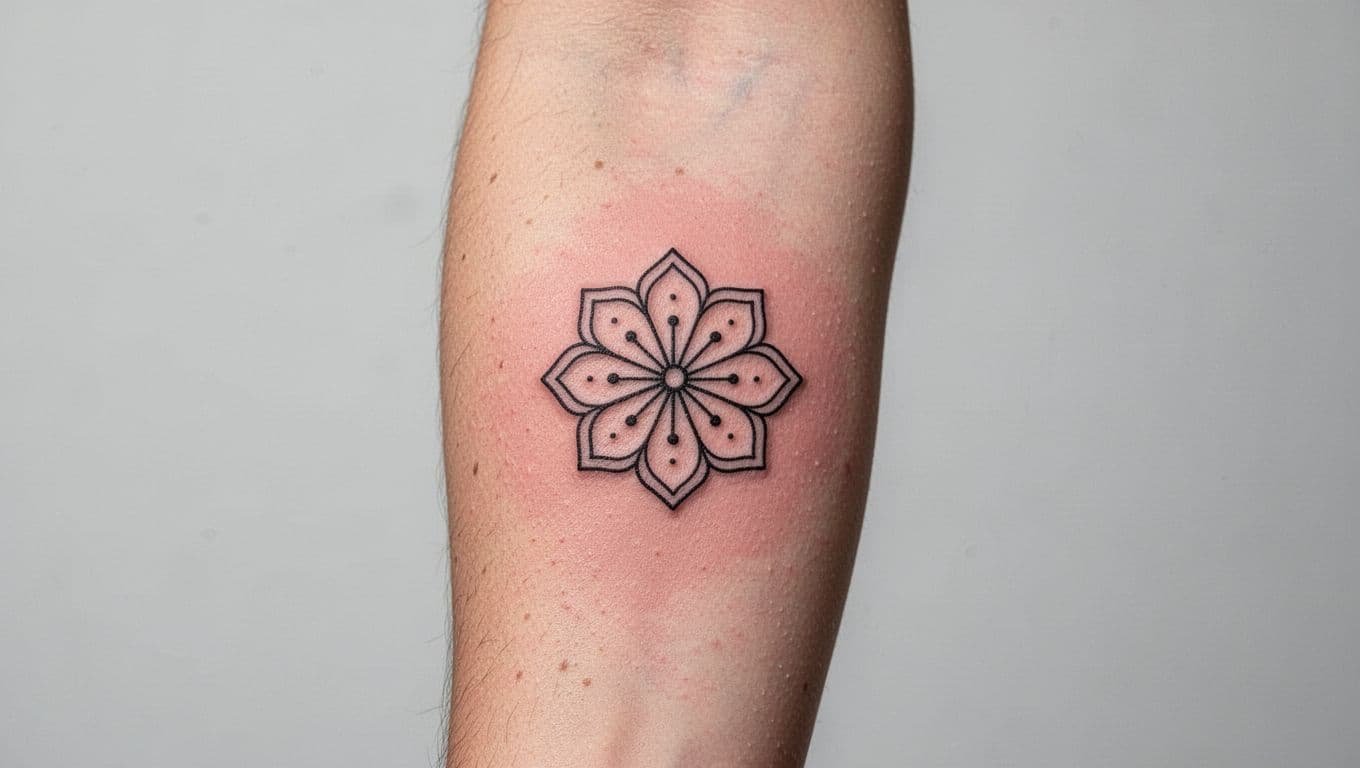
Choose line weight for lasting readability
Ultra-fine lines work best for interior texture, such as small veins, decorative curls, light rays, or subtle dotwork. They shouldn’t carry the entire design. A slightly stronger outer boundary gives the ornament a stable silhouette, so the main shape remains recognizable even if the finer details soften.
That contrast works especially well in small forearm tattoos. The outer edge can define a diamond, flower, crescent, or medallion, while thinner lines add decoration inside it. Current fine-line guidance also emphasizes that spacing should increase as line weight increases, rather than forcing more detail into the same area. You can review more about fine-line tattoo longevity before choosing an artist.
Match the size to the amount of detail
Use these size guidelines when planning an ornamental forearm tattoo:
- Under 2 inches: Choose one simple symbol with limited interior detail, such as a crescent, star, leaf, or small geometric charm.
- 2 to 4 inches: This range often gives a small ornamental piece enough breathing room for a border, separated dots, and modest filigree.
- 2 to 6 inches: Many fine-line forearm tattoos fall within this range, depending on the design’s detail, orientation, and exact placement.
Before agreeing to the final design, ask to see your artist’s healed-work portfolio, not only fresh tattoos. Request a size-specific stencil as well, then inspect it with your arm relaxed, rotated, and viewed from several feet away. A design that looks slightly spacious today will usually remain easier to read tomorrow.
How to find an artist who can make ornamental details look clean
Ornamental, geometric, and fine-line tattooing overlap, but they require different skills. A strong realism artist may not produce clean symmetrical geometry, while a fine-line specialist may not have experience planning a balanced wraparound design. Look for an artist whose portfolio shows consistent line weight, controlled dotwork, clean symmetry, and thoughtful placement on curved body areas.
Review healed work, not only fresh tattoos
Fresh tattoos often look darker, sharper, and more precise than they appear after healing. Ask to see healed examples whenever possible, preferably in natural light and at least several weeks after the appointment. The best examples should still show readable lines, even spacing, crisp edges, and dotwork that hasn’t become patchy.
Pay close attention to repeated details. Do mirrored sections match? Do parallel lines stay even across the curve of the forearm? Are corners clean, or do they look shaky and swollen? You can also review healed fine-line tattoo examples to understand why healed results offer more useful information than fresh photographs.
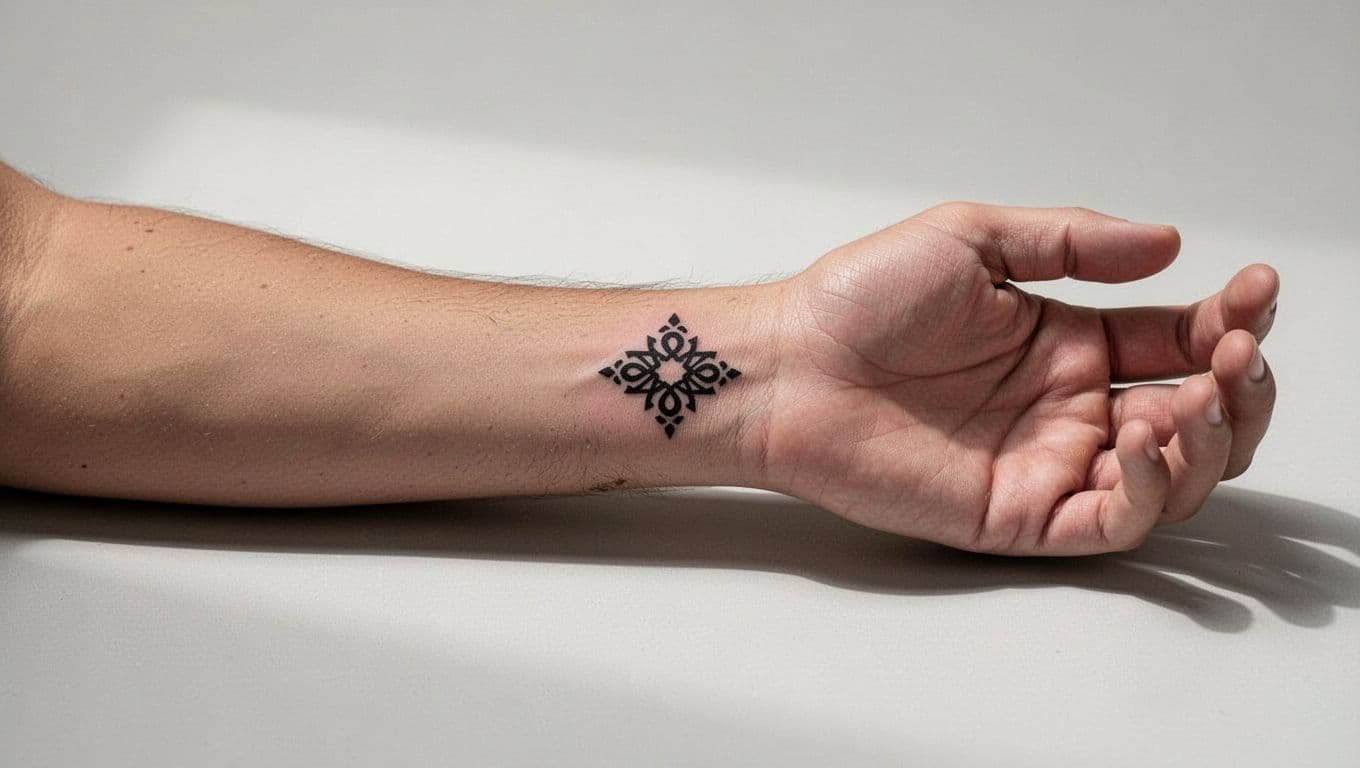
Prepare for a more useful consultation
Before contacting an artist, gather the details they’ll need to judge the design properly. Send:
- A clear photo of the exact forearm area, with your arm relaxed and visible from the intended angle.
- Your preferred size in inches or centimeters, rather than saying only that you want it “small.”
- Reference images that show the ornament, line style, spacing, or mood you prefer.
- The side of the arm you want, such as the inner, outer, or side forearm.
- Information about whether the tattoo may connect to a future cuff, sleeve, or nearby design.
Ask how the artist will simplify the ornament for its final size. Find out which lines need strengthening, whether any dots should be removed, and how the stencil will account for the arm’s curve. The stencil should look balanced with your arm relaxed, rotated, and slightly bent.
Finally, discuss black ink versus black-and-gray. Black ink can give small geometry stronger contrast, while gray shading may create a softer finish. Neither choice works for every design or skin tone, so let the artist assess the size, detail, placement, and your desired result together.
Preparing for Your Small Forearm Tattoo and Caring for It Afterward
Good preparation can make your appointment more comfortable and give your ornamental forearm tattoo a better start. Afterward, gentle care protects fine lines while the skin heals, so follow your artist’s written instructions even when they differ from general advice.
Prepare your skin and body before the appointment
Eat a full meal one to two hours before your session. A balanced meal can help you feel steadier during the appointment, especially if you’re nervous or expect to sit for a while. Drink enough water throughout the day, but avoid alcohol for at least 24 hours beforehand.
Arrive with clean, healthy skin. The forearm should be free from sunburn, fresh irritation, cuts, or heavy products. Avoid tanning before your appointment, and tell your artist about any skin reaction or medication that may affect healing. Wear loose clothing that leaves the forearm accessible without creating pressure around the fresh tattoo.
Ask your artist about the bandage before you leave. Different studios use different coverings, and the removal time depends on the material and the tattoo itself.
What to expect during the appointment
Your artist should work with clean, properly sterilized equipment and explain the basic aftercare routine before you go. Pay attention to the instructions for removing the bandage, washing the tattoo, and applying moisturizer. Studio-specific directions take priority because your artist knows which products and covering were used.
A small ornamental tattoo may feel sore, warm, or slightly swollen afterward. Those reactions can occur during early healing, but they should gradually improve rather than become more intense.
Keep the tattoo clean and lightly moisturized
Wash your hands before touching the tattoo. Once your artist says it’s time to remove the covering, clean the area gently with lukewarm water and mild, fragrance-free soap. Don’t scrub, use a washcloth, or hold the tattoo under a strong shower stream. Pat it dry with a clean paper towel, then apply a thin layer of fragrance-free moisturizer if your artist recommends it.
Wear loose, clean clothing while the forearm heals. Avoid picking peeling skin or scratching itchy areas, since both actions can irritate the tattoo and pull at healing skin. Many aftercare guides also advise avoiding pools, baths, hot tubs, and other soaking for about two to three weeks, although healing time varies.
For more practical advice on gentle washing, moisturizing, and protecting fresh ink, review these tattoo aftercare tips.
After the skin fully heals, protect the tattoo with broad-spectrum SPF 30 or higher. Ultraviolet exposure can fade fine ornamental lines and soften small details over time. Contact your artist or a qualified medical professional if you notice unusual swelling, spreading redness, severe pain, pus, fever, chills, or another sign that the tattoo isn’t healing normally.
Mistakes to Avoid When Planning a Delicate Ornamental Forearm Tattoo
A delicate forearm tattoo can look simple, but small artwork still needs careful planning. The wrong size, placement, or line weight can make a balanced ornament look crowded before it has time to heal.
Avoid designs that are too detailed for their size
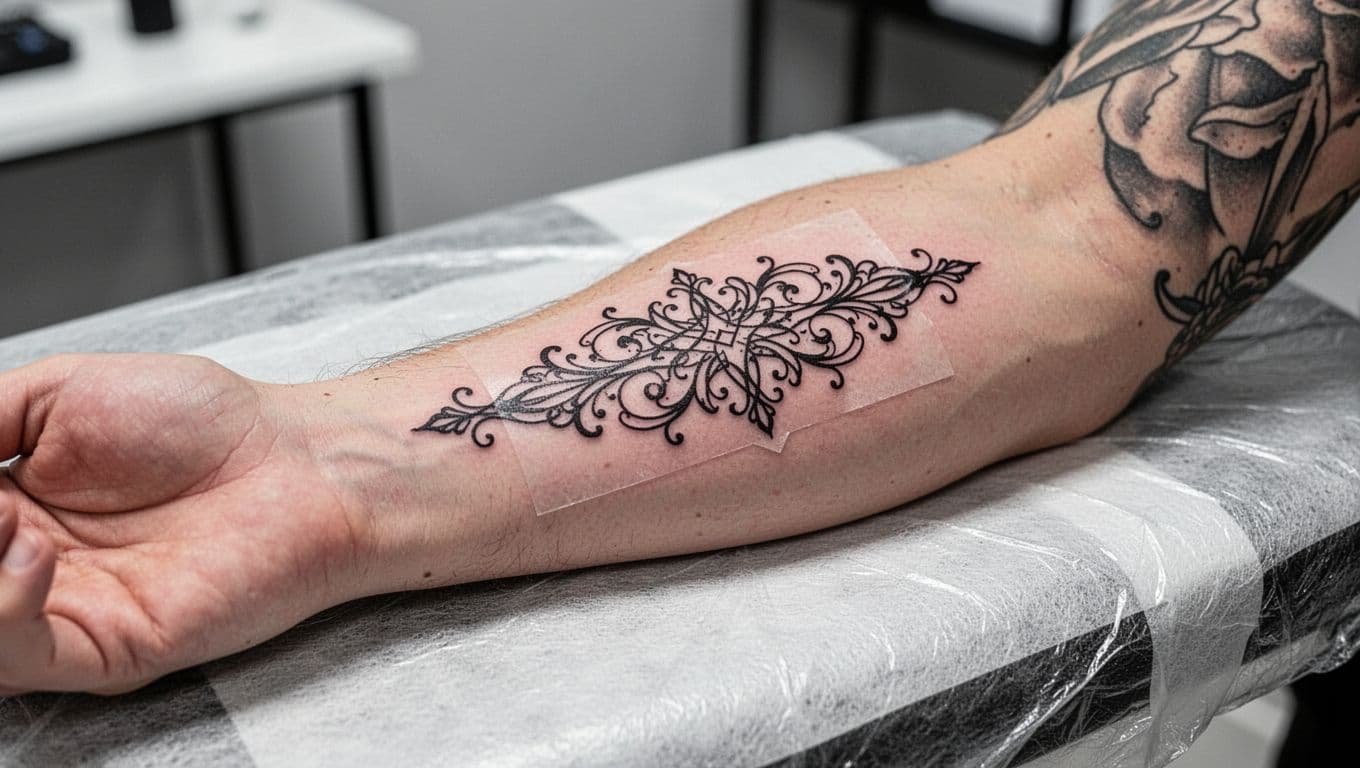
Tiny lacework, dense mandalas, and tightly packed dotwork can lose definition when reduced to fit a narrow forearm. A tattoo can be small and still need enough space for its lines to age well. Ask your artist which details should be removed, enlarged, or given more negative space.
Copying a reference image without adapting it to your arm is another common mistake. A design made for a flat shoulder or broad back may look stretched on the forearm. Your artist should adjust the proportions, direction, and spacing to match your arm’s width and natural taper.
Also, avoid placing a hard border directly across the wrist crease. Movement and friction can make that edge heal unevenly. Leave a small gap above the crease or use a softer pendant-style ending instead.
Review the stencil from every angle
Don’t approve the stencil while your arm stays flat on the table. Look at it with your palm facing up, palm facing down, elbow bent, and wrist relaxed. Rotate your arm and check whether the ornament still looks centered or whether a border twists unexpectedly.
A stencil that looks balanced from one angle may appear tilted when the forearm rotates.
Use stronger outer lines where the design needs structure. Hair-thin lines throughout the entire tattoo may fade or blur sooner, especially in areas exposed to sunlight and daily friction. Before booking, review healed work that matches your preferred size and detail level.
Choose safety and skill over the lowest price
A low quote shouldn’t decide who tattoos you. Check the studio’s local license or permit, clean setup, sterilization practices, and use of sealed, single-use needles. New York’s body art safety requirements illustrate why studio regulation and sanitation deserve attention.
Ask for written aftercare instructions before leaving. If the ornament will take multiple sessions, plan roughly four to six weeks between appointments, or wait until your artist confirms the skin has fully healed before adding more ink. If you may expand the piece later, compare full-back tattoo ideas for women before locking in a forearm design that could become part of a larger ornamental plan.
Conclusion
The strongest small ornamental forearm tattoos balance a clear focal shape with thoughtful placement, readable line weight, and enough negative space. A design should remain easy to recognize as the arm moves, rather than forcing the most detail into the smallest possible area.
Choose one or two ideas that genuinely fit your taste, then ask an experienced ornamental tattoo artist to adapt the proportions, spacing, and direction to your forearm. Before the session, review the stencil with your arm relaxed, rotated, and slightly bent. This check can reveal whether the ornament stays centered and balanced from several angles.
A simple cuff, floral ornament, mandala, charm, or vertical design can feel highly personal when it’s planned around your body and lifestyle. The best choice is the one that looks clear at the right size, suits your daily routine, and still feels like something you want to wear for years.
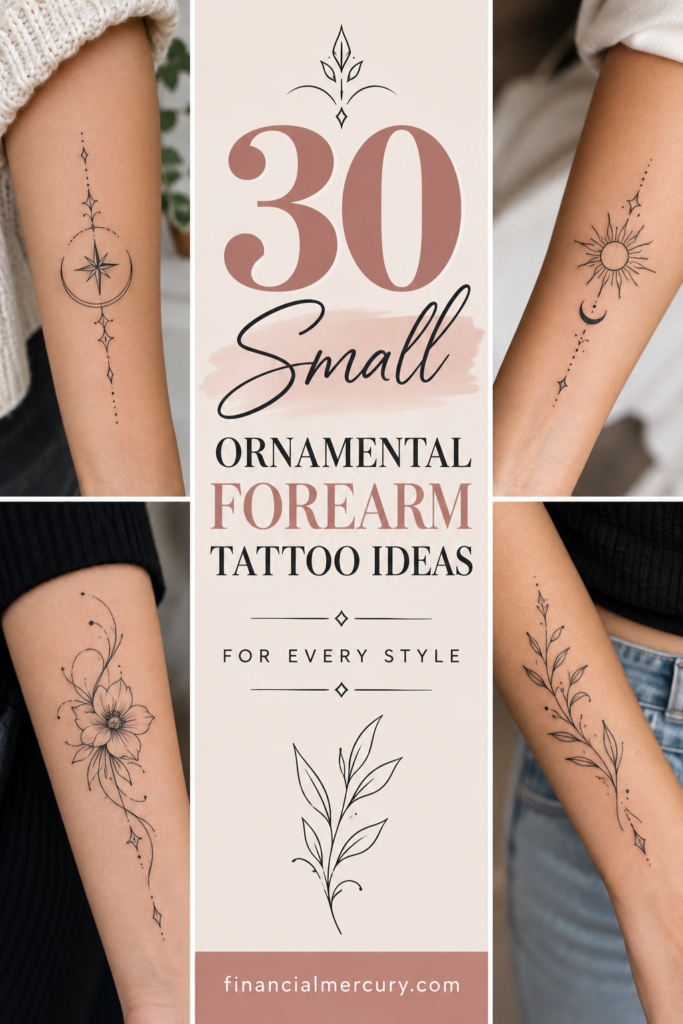
Save the pin for later

- 23 Wrist Tattoo Ideas for Women That Feel Personal and Stylish - September 14, 2026
- 30 Small Ornamental Forearm Tattoo Ideas for Every Style - September 14, 2026
- 34 Botanical Tattoo Ideas for Nature Lovers - September 10, 2026
Leave a Reply