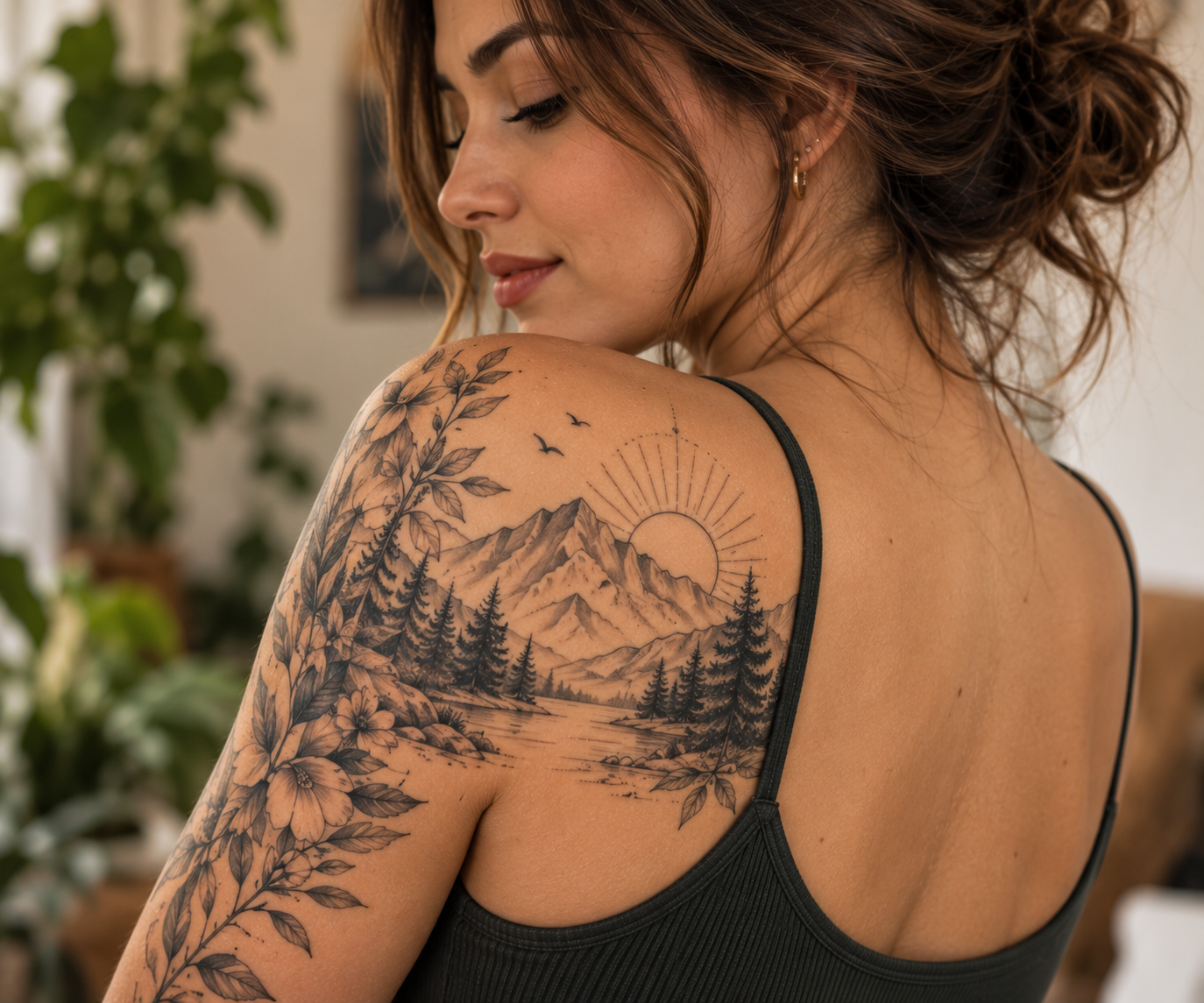
50 Nature Tattoo Ideas for Women: Florals, Mountains, Animals, and Fine-Line Designs
A tattoo should mean something years from now, and that’s exactly why nature tattoos never go out of style. A sprig of lavender or a mountain range doesn’t chase trends; it holds personal meaning that grows with you.
There’s a reason so many women gravitate toward nature-inspired designs. They connect you to places and moments that matter, from childhood forests to favorite hiking trails. They also tend to be delicate and fine-lined, which means they age beautifully and work almost anywhere on the body.
Below you’ll find 50 nature tattoo ideas for women, grouped by style and theme: florals and botanicals, mountains and landscapes, animals, birds, and celestial touches. You’ll also get practical guidance on choosing placement and caring for fresh ink so your tattoo heals clean and stays sharp.
Scroll through, save your favorites, and see which design feels like yours.
50 Nature Tattoo for Women That Celebrate the Great Outdoors
Here’s the full collection, organized into four themes so you can jump straight to the style that fits you. Each idea comes with a quick note on meaning or placement. Mix and match freely; some of the best tattoos combine two or three of these concepts into one piece.
Floral and Botanical Tattoos
Florals are the backbone of nature tattooing for good reason. They age well, suit almost any placement, and each flower carries its own quiet symbolism.
- Wildflower bouquet on the forearm, perfect for free spirits who can’t pick just one bloom.
- Single-stem lily running along the collarbone, elegant and understated.
- Cherry blossom branch curving over the shoulder, a nod to fleeting beauty.
- Lavender sprig on the inner arm; lavender has long symbolized calm and serenity.
- Eucalyptus stem in soft green or black ink, popular for its clean, airy look.
- Peony on the thigh or ribs, a statement flower tied to prosperity and honor.
- Rose with thorns for those who like a little edge with their romance.
- Birth flower tattoo (January’s carnation, July’s larkspur, and so on), a subtle tribute to your birth month or a child’s.
- Poppies scattered along the ankle, remembering loved ones or honoring remembrance.
- Fern frond wrapping the wrist, a symbol of new beginnings.
- Daisy chain circling the ankle like an anklet.
- Botanical illustration style sunflower on the shoulder blade, detailed and scientific-looking.
Mountain, Forest, and Sky Designs
Landscape tattoos reward simple line-work. A few clean strokes can capture an entire scene, which is why these designs stay sharp for decades.
- Minimalist mountain range on the spine, one of the most requested designs for hikers and climbers.
- Pine tree line running along the inner arm, evoking Pacific Northwest trails.
- Forest silhouette in solid black across the ribs, moody and striking.
- Sunrise over peaks with the sun peeking between two summits, a favorite for new chapters.
- Moon phases stacked vertically down the spine or wrapped around the forearm.
- Stars and constellations, with your zodiac sign as the centerpiece.
- Wave-and-sun combo on the ankle, balancing water and fire energies.
- Circling birds above a single tree, suggesting freedom.
- Topographic map lines of a real place you love, like a national park or hometown lake.
- Misty valley rendered in fine dot-work for a softer, atmospheric feel.
- Lone cabin in the woods, a charming nod to quiet escapes.
- Compass and mountains paired on the ribs for travelers who never quite settle.
Animal and Insect Tattoos
Animal tattoos pack meaning into small packages, and they photograph beautifully in fine-line style.
- Butterfly on the wrist or collarbone, the classic symbol of transformation.
- Honeybee near the ankle, honoring hard work and community.
- Hummingbird on the shoulder blade, representing joy and resilience.
- Leaping deer or delicate antlers on the forearm, tied to grace and gentleness.
- Sly fox curled along the thigh, for clever, independent types.
- Snake winding down the spine or ankle, a symbol of rebirth since they shed their skin.
- Koi fish swimming upstream on the arm, a nod to perseverance.
- Luna moth on the upper back, associated with intuition and renewal.
- Tiny sparrow behind the ear, an old sailor’s symbol of safe returns.
- Horse in motion along the ribs, wild and unbridled.
- Spider in fine-line style on the inner elbow, creative and misunderstood.
- Whale breaching in simple black work, embodying calm strength.
Delicate Fine-Line and Minimalist Nature Tattoos
Small designs are ideal for first-timers. They heal faster, cost less, and stay hidden when you need them to.
- Tiny leaf sprig on the inner wrist, barely there but meaningful.
- Single snowflake behind the ear, unique down to its geometry.
- One-line mountain outline on the finger or wrist.
- Minimalist sun with short rays on the ankle.
- Single feather drifting along the collarbone, symbolizing freedom.
- Water droplet on the finger, small and quietly striking.
- Matching wave tattoos for sisters or best friends, each on the inner arm.
- Two halves of one mountain, one on each friend, complete only together.
- Micro wildflower cluster on the ankle.
- Sun and moon pair on opposite wrists for couples or close friends.
- Seedling in a thin outline circle, a reminder of growth.
- Raindrop trio behind the shoulder.
- Thin crescent moon on the ribcage, discreet enough for work.
- Breathing leaf (a leaf split by a vertical line) on the forearm, a favorite among yoga lovers.
Whichever direction you go, bring reference photos to your artist rather than exact copies. A good tattooer will adjust the linework to fit your body and their own style, and that collaboration is what turns a borrowed idea into something that feels genuinely yours.
How to Choose the Right Nature Tattoo for You
Inspiration is the easy part. With 50 ideas on the page, the real work is narrowing them down to the one design you’ll be happy wearing for decades. Three decisions make the difference: what the design means, where it lives on your body, and which style renders it. Get those right and the rest falls into place.
Match the Design to Its Meaning
A tattoo outlives trends, so start with your story rather than the design itself. Ask what you want to carry with you. A mountain range might mark a trail that changed your life; a lavender sprig might honor a grandmother’s garden. Birth flowers work well for children and loved ones, while animals like the butterfly or snake suit anyone marking a personal transformation.
Write down two or three memories, values, or places that matter most, then look for a plant, animal, or landscape that connects to them. Wildflowers suit free spirits, koi fish suit perseverance, and a lone cabin suits someone who craves quiet. When the meaning is yours, the tattoo never feels dated, even if the style around it shifts.
One caution: skip anything chosen purely because it looked good on someone else’s feed. Popularity fades; personal history doesn’t.
If you can’t explain why a design matters to you in one sentence, you’re not ready to get it yet.
Pick the Best Placement for Your Design
Placement shapes how a tattoo looks, feels, and fits your daily life. Large landscapes need room to breathe, so ribs, thighs, the upper back, and full forearms suit mountain scenes and forest silhouettes. Small florals and minimalist lines thrive in tight spots like the wrist, ankle, behind the ear, or along the collarbone.
Pain and visibility vary by spot, so weigh both honestly. Here’s a quick comparison:
| Placement | Pain Level | Visibility | Best For |
|---|---|---|---|
| Wrist | Moderate | High | Tiny florals, words, leaf sprigs |
| Ankle | Moderate | Medium | Small motifs, chains of daisies |
| Ribs | High | Low | Landscapes, long vertical designs |
| Thigh | Low | Low | Larger florals, statement animals |
| Upper back | Low to moderate | Low | Medium scenes, moon phases |
If you need a work-friendly tattoo, choose somewhere you can cover with clothing. First-timers often do better starting on the thigh or outer arm, where skin is forgiving and pain runs milder. Remember that fine-line work on high-friction areas like fingers and wrists fades faster and may need touch-ups sooner than you’d like.
Choose a Style: Fine-Line, Watercolor, or Blackwork
The same mountain looks completely different in each style, so decide on the aesthetic before you book. Fine-line uses thin, single-weight needles for delicate, minimal designs; it’s the most popular choice for florals and tiny motifs. Watercolor layers soft, blended color for a painted look, though it can fade faster than other styles. Blackwork relies on bold solid black and heavy contrast, ideal for forest silhouettes and statement pieces. Realistic styles capture photographic detail but need significant space and a specialist’s hand.
Once you know the style, find an artist whose portfolio already shows it. A skilled fine-line artist may struggle with watercolor, and vice versa. Scroll their healed-work photos, not just fresh ones, since healed tattoos show how the style actually holds up over years. Then bring your references and let them adapt the design to your body and their hand. That collaboration is what turns a pinned idea into a tattoo that belongs to you.
What a Nature Tattoo Costs and How to Prepare
Pricing varies more than most first-timers expect, but the math is simple once you know the two main factors: size and artist experience. Budget ahead and the appointment itself becomes easy.
What You’ll Actually Pay
A tiny fine-line piece, like a single wildflower or a snowflake behind the ear, usually runs $80 to $200 as a minimum shop charge. Even 15 minutes of work costs this baseline because setup, needles, and supplies are fixed.
Larger custom work starts around $300 and climbs from there. A mountain scene across the ribs or a detailed botanical bouquet can take several hours. Many established artists charge hourly, and rates typically fall between $100 and $250 depending on the artist and city. A fine-line specialist in Los Angeles bills differently than a small-town studio. Always ask for an estimate at your consultation so there are no surprises.
How to Prep for Your Appointment
Good prep makes the session smoother and the healing easier. A few days out, skip alcohol and keep the placement area out of the sun; tattooing over sunburned skin is a no-go, and most artists will reschedule you.
- Eat a solid meal an hour or two before your appointment. Low blood sugar plus adrenaline is a recipe for dizziness.
- Hydrate well for 24 to 48 hours beforehand. Well-hydrated skin takes ink better.
- Wear loose clothing that gives the artist easy access to your placement area.
- Skip numbing cream unless you’ve discussed it with your artist first; some products affect how ink settles.
- Bring snacks and water for sessions longer than two hours.
Questions to Ask Your Artist
The consultation is your chance to steer the design, so come with questions rather than just a reference photo. Ask to see where the stencil will sit before any needle touches your skin, and don’t hesitate to request a shift in size or angle. Confirm whether the artist works from their own portfolio style or can match your references. Finally, ask about aftercare specifics and whether a touch-up is included. A confident artist will answer all of it without flinching.
Caring for Your Tattoo So It Heals Beautifully
Healing is where a good tattoo either stays crisp or turns muddy. Fine-line florals and mountain silhouettes depend on clean lines, so how you treat the skin in the first two weeks matters as much as the artist’s work. The routine is simple once you know the steps.
Your Day-by-Day Aftercare Routine
Leave the wrap or second-skin bandage on for as long as your artist directs, usually a few hours up to a few days. When it’s time, wash gently with lukewarm water and a fragrance-free soap, using clean hands only. Pat dry with a paper towel, never a shared bath towel.
For the next two weeks, moisturize two or three times a day with a thin layer of unscented lotion. More is not better; a suffocated tattoo heals worse than a slightly dry one. Also keep the area away from swimming pools, lakes, and direct sun until it’s fully healed.
- Wash gently twice a day with fragrance-free soap.
- Apply unscented lotion in thin layers.
- Avoid swimming, saunas, and direct sunlight for two weeks.
- Wear loose clothing over the area.
- Never pick or scratch flaking skin; the flakes fall off on their own.
If redness, swelling, or oozing worsens after day three, or you notice warmth spreading beyond the tattoo, contact your artist or a doctor. Infection is rare, but it’s not something to wait on.
One last note: fine-line tattoos fade faster than bolder styles. Plan on touch-ups every few years to keep those delicate lines sharp.
Conclusion
Nature tattoos give you endless room to make something personal, whether that’s a bold mountain scene across your ribs or a tiny leaf sprig on your wrist. The best choice is always the one tied to your own story, not someone else’s feed.
Save the ideas that caught your eye, then take your time finding an artist whose healed work matches the style you want. A design with real meaning behind it will still feel right decades from now.
So which one would you pick: the wildflower bouquet, the moon phases, or something entirely your own? Drop your favorite in the comments, we’d love to hear it.
Save pin for later

- How to Design Your Own Tattoo Without Regret: A Step-by-Step Guide - September 23, 2026
- 20 Daisy Tattoo Design Ideas With Meanings, Placements, and Style Tips - September 23, 2026
- 20 First Tattoo Ideas for Women: Beginner-Friendly Designs You’ll Still Love in 10 Years - September 23, 2026
Leave a Reply