
Iconic Traditional Tattoos: Meanings Behind 8 Classic Designs
Traditional tattoos draw the eye with bold outlines, vivid color, and familiar symbols, but their appeal goes beyond the look: each design can carry a personal story as well as a shared association. An anchor might suggest stability to one person and recall a particular voyage to another, because no tattoo image has one fixed meaning.
Rooted in maritime tattooing and popularized by artists such as Norman Collins, known as Sailor Jerry, American traditional designs have a history as recognizable as their style. The meanings behind classic motifs can shift with time and with the person wearing them, so choosing one takes more than matching an image to a definition. Here’s a closer look at the history, iconic symbols, and practical ways to choose a design that feels right for you.
Watch a video on sailors’ tattoos and their meanings
How traditional tattoo style became a visual language
American traditional tattooing developed through maritime travel, military life, and busy port-city shops. Its familiar designs became a shared visual language because people could recognize them quickly, while still attaching personal stories to each image.
Bold lines and simple colors made the designs last
Strong black outlines and large, clear shapes help traditional tattoos remain readable, even as they age. Artists typically relied on a limited palette, often red, yellow, green, and blue, rather than subtle shading or fine detail. That clarity gave a rose, anchor, or swallow an immediate presence on the skin.
Tattoo flash helped spread this look. Shops displayed sheets of pre-drawn designs, giving customers a set of images they could choose or adapt. As sailors and other travelers moved between ports, they carried familiar motifs with them, and flash made those designs easier to repeat.
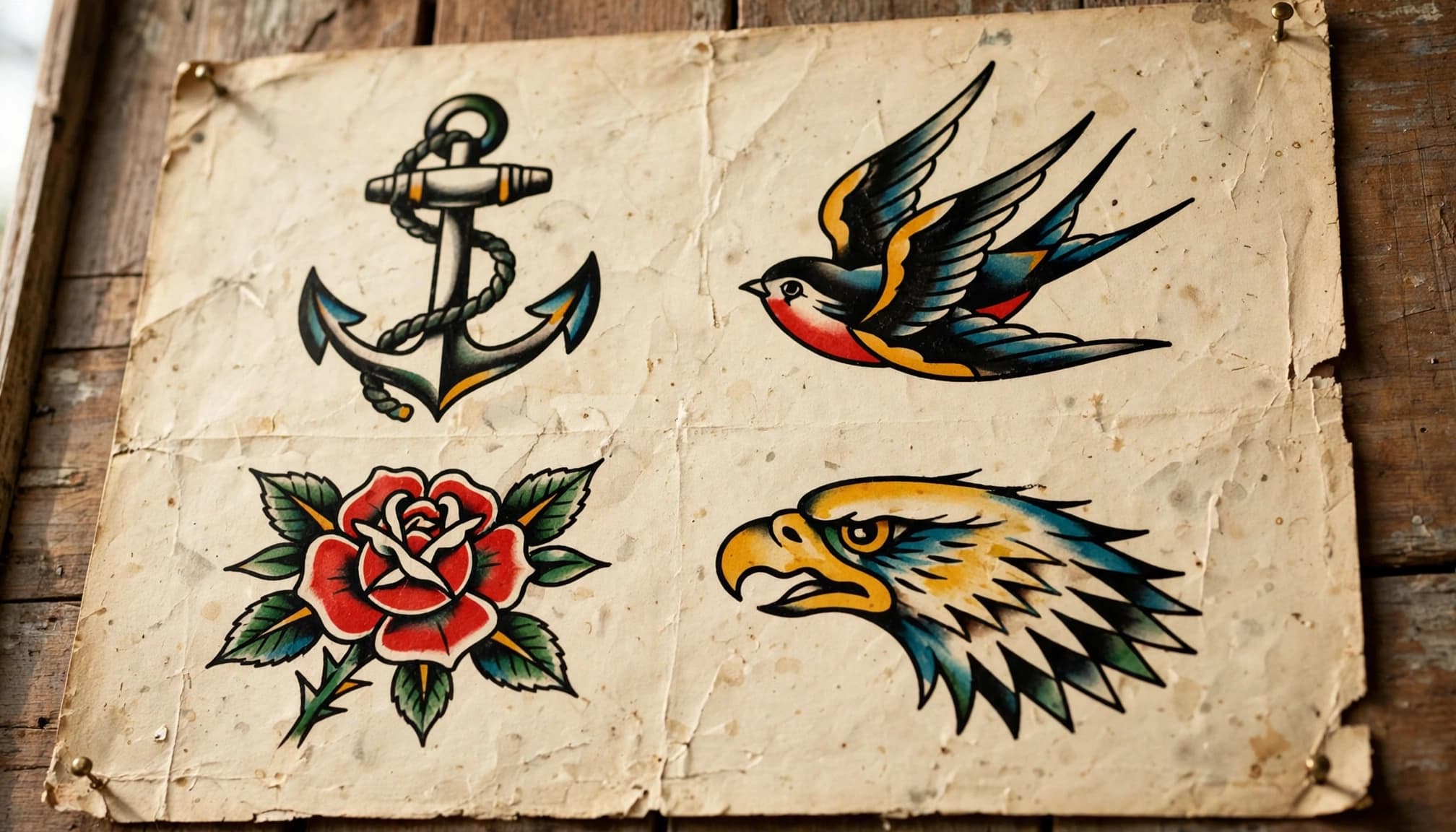
Because the images were direct and memorable, they could communicate at a glance. An anchor might suggest steadiness or a connection to the sea, while a swallow could recall travel and the hope of returning home. The design offered a shared reference point, but its meaning still depended on the person wearing it.
Sailors, artists, and cross-cultural influences shaped the tradition
Port cities brought tattooers into contact with sailors, merchant crews, military personnel, and travelers. Ships connected distant communities, while naval and military culture helped popularize tattoos tied to service, journeys, and loved ones left behind. These settings helped make maritime imagery central to American traditional tattooing.
Artists gave the style recognizable form without creating it alone. Norman “Sailor Jerry” Collins built a major body of work in Honolulu, while Bert Grimm became influential through shops and flash that circulated widely. Their designs helped establish visual conventions, but the tradition grew through many tattooers, customers, and routes of exchange.
Its history also reaches beyond American shops. Pacific tattoo traditions, European maritime practices, and Indigenous cultures all belong to the broader history of tattooing and its movement across communities. Those traditions are distinct, not interchangeable; contact and exchange shaped tattoo history in complex ways. American traditional tattooing emerged within that wider story, rather than from one artist, shop, or culture.
Iconic traditional tattoos with deep meanings, from roses to nautical stars
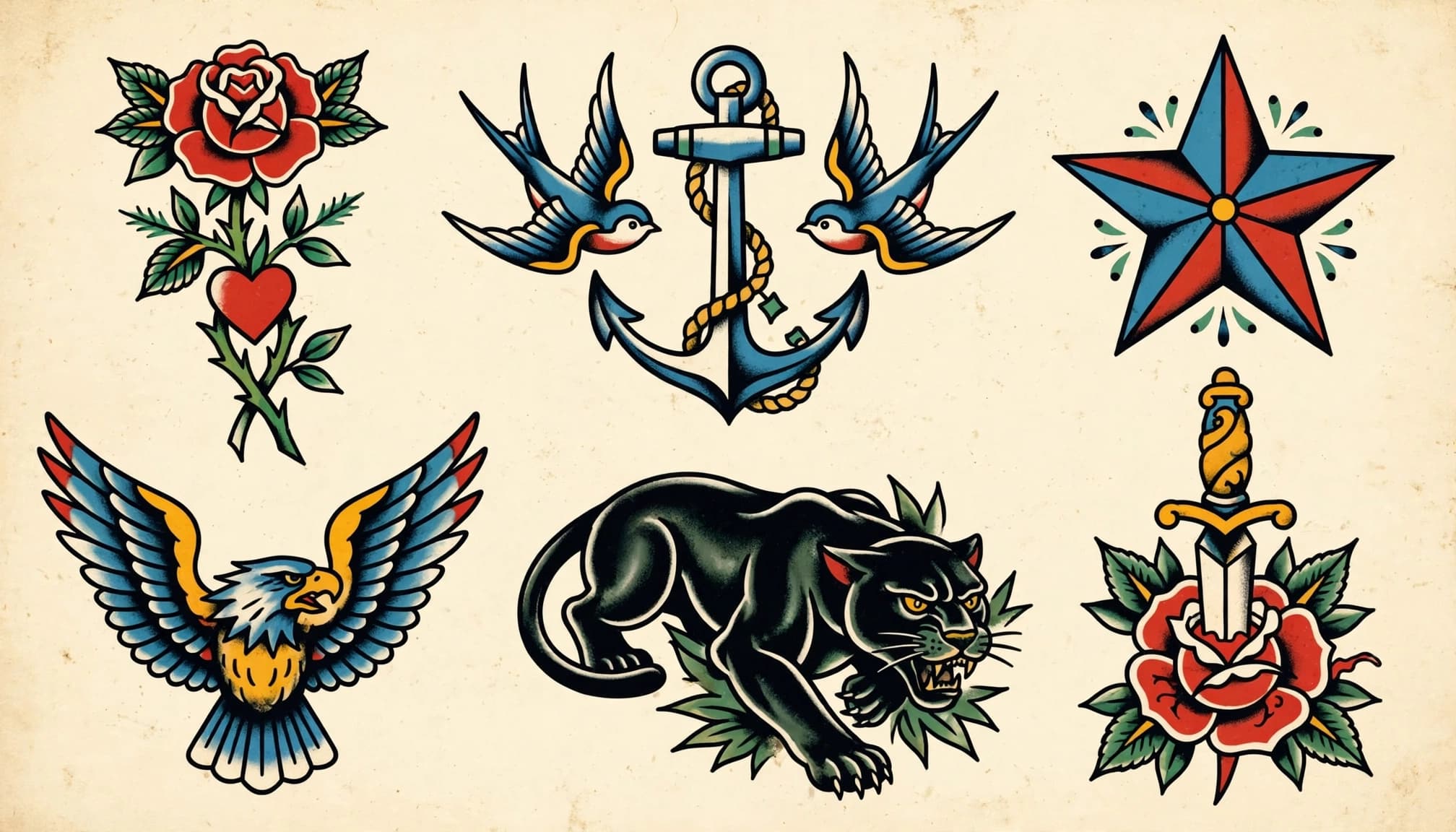
Classic American traditional tattoos pair bold outlines and clear shapes with symbols that feel familiar at a glance. Their meanings aren’t fixed, though; a design can carry an inherited association, a personal memory, or both.
Roses and hearts can celebrate love, grief, and devotion
A rose is often associated with love and beauty, but its thorns add another layer: pleasure can come with pain. For some wearers, the flower recalls a relationship or a loved one; for others, it honors someone who has died. Its familiar shape and strong color also make it a natural fit for traditional tattooing, where bold designs need to stay legible.
A heart often expresses love, loyalty, heartbreak, or tribute. Adding a banner with a name or a short phrase can make the meaning more personal and clear. Still, the image doesn’t need a label to hold meaning. A plain heart may honor a bond the wearer prefers to keep private.
Anchors, swallows, and nautical stars point to loyalty and direction
Anchors are often associated with stability, loyalty, safe harbor, and life at sea. A wearer might choose one to honor a maritime connection or to represent a steady presence during a difficult time. Its simple, balanced shape has also helped it remain a staple of traditional tattoo flash.
Swallows often bring travel, distance, loyalty, and return to mind. In sailor imagery, they can suggest the hope of making it home after a long voyage. Meanwhile, a nautical star is commonly linked with guidance and finding one’s way, whether home means a place, a person, or a sense of direction. These associations aren’t a universal code; each wearer brings their own story to the design.
Eagles and panthers make bold statements about strength
Eagles are often associated with strength, freedom, pride, and power. They also appear in military settings, where the image may connect to service or national identity. Yet an eagle tattoo doesn’t carry one automatic political message. Its meaning can be personal, and its dramatic wings make it a popular choice for a large, high-impact design.
Panthers often suggest courage, ferocity, danger, or bold energy. Their compact, muscular forms suit the style’s thick outlines and vivid colors, giving the image an immediate presence. Some people choose a panther as a sign of confidence; others simply like its fierce look.
Daggers can represent danger, sacrifice, or a fresh start
A dagger can point to courage, betrayal, survival, or sacrifice. Some wearers choose it to mark a hard experience, while others use the blade to represent cutting away the past. Because the design is direct and easy to recognize, it has remained a striking traditional motif.
The surrounding images can change how a dagger reads. A blade through a heart may suggest heartbreak or sacrifice, while a dagger paired with a rose can place beauty beside pain. The combination adds context, but its meaning still belongs to the person wearing it.
Why a tattoo’s meaning depends on its story and setting
A traditional tattoo can carry a familiar association without having one official translation. Its meaning depends on who wears it, where the image comes from, and what the wearer connects to it. Sailor lore, military customs, tattoo-shop flash, and personal memories all shaped how classic designs were understood.
Traditional meanings can shift with the wearer
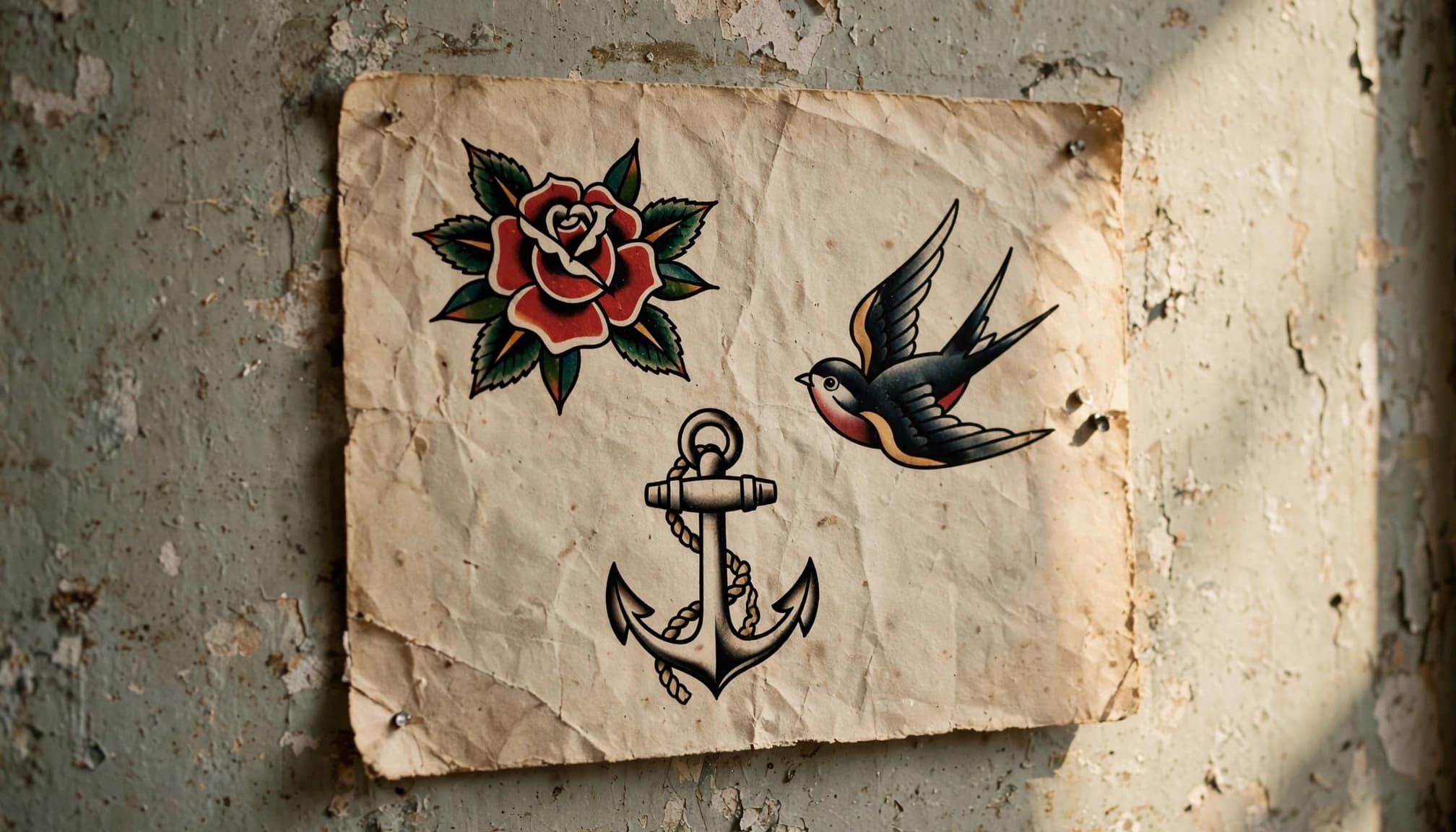
In maritime communities, tattoos could record a shared experience. A swallow, for example, became associated with time at sea and the hope of returning home. Some sailors used birds to mark distance traveled, while others chose the image for reasons tied to their own lives. The Naval History and Heritage Command’s account of sailors’ tattoos describes how designs became part of naval culture, where their meanings often made sense within a particular community.
Military service added more layers. A tattoo might recall a ship, a deployment, or the people someone served beside. Meanwhile, tattoo shops helped circulate familiar designs through flash sheets, giving customers recognizable images they could select, adapt, or make their own. A rose from a shop wall might honor a family member, recall a relationship, or simply appeal to someone who loves the flower’s shape and color.
The same flexibility applies to anchors. One person may connect an anchor with a relative who served at sea; another may choose it as a reminder of stability during a difficult period. For someone else, it may be a striking design with no symbolic meaning beyond its appearance.
These associations are conventions, not rules. Popular explanations can offer useful context, but they can’t tell you what a tattoo means to the person wearing it. A symbol’s story may come from history, a family memory, a personal milestone, or the setting in which it was first chosen. Treat traditional meanings as background, then consider the wearer’s own reasons.
How to choose a traditional tattoo that feels personal
A classic motif gives you a starting point, not a fixed meaning. Decide what you want the tattoo to express, then shape the image around your own memory, relationship, or experience. For more inspiration, browse tattoo ideas with personal meaning.
Match the image, details, and placement to your idea
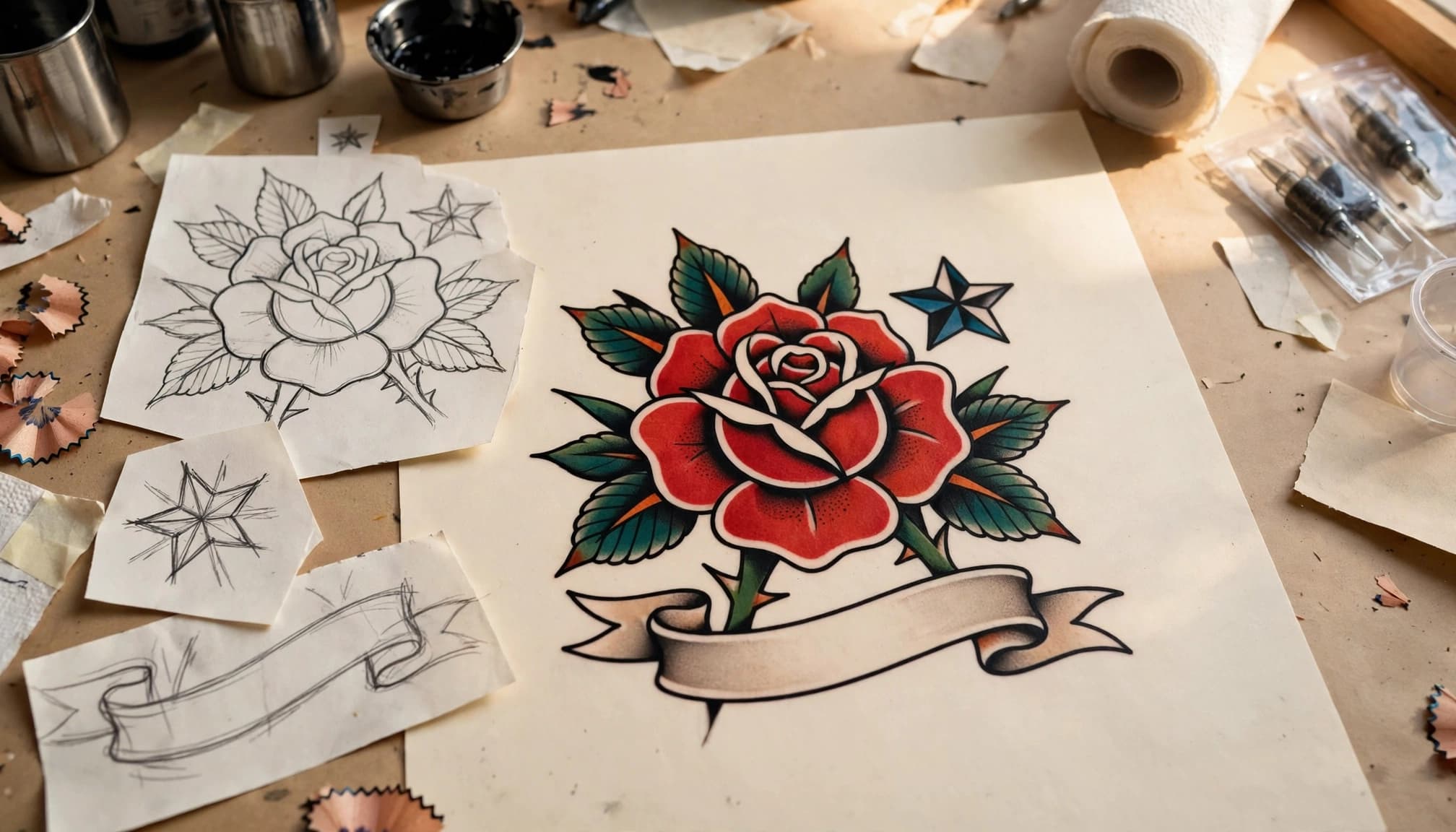
Start with the feeling or story you want the design to carry. A rose might honor someone you love, while an anchor could remind you to stay grounded. You can also choose a symbol for its look, then let added details connect it to your life.
Discuss possible additions with your artist. A banner, flowers, stars, or another small element can make a familiar image more specific. For example, a rose paired with a star might connect affection with a personal sense of direction. Keep the design focused, though. Traditional tattoos rely on bold outlines and clear shapes, so too many small details can compete with the main image.
Size and placement also affect how clearly a tattoo reads. A compact design may need simplified details, while a larger area can give outlines and surrounding elements more room. Ask your artist how the image will look at its actual size and how it will follow the body’s shape. Before approving the final stencil, check its position while standing and moving naturally.
Choose an artist who understands traditional design
Look beyond fresh photos when reviewing an artist’s portfolio. Healed work shows how line weight, color, and spacing hold up on skin. Compare examples close to your intended size and placement, since a large shoulder tattoo may not show how a small wrist design will read.
During a consultation, ask how the artist approaches bold outlines, color choices, and custom changes. A skilled traditional artist can adapt a motif while keeping its shapes clear. They should also explain when a detail needs to be enlarged, simplified, or removed to preserve legibility.
A thoughtful conversation helps you distinguish a personal design from a direct copy of flash. Bring reference images if they clarify your taste, but explain what you want the tattoo to mean rather than asking the artist to reproduce another person’s work. Before booking, review the FDA’s tattoo safety guidance and ask the studio about its hygiene practices.
What to check before getting tattooed, and how to care for it
A new tattoo is healing skin, so studio hygiene and aftercare matter as much as the design. Before booking, ask how the artist keeps equipment sterile and what care your tattoo will need afterward.
Look for clean tools and clear studio hygiene practices
A professional studio should be clean, and the artist should answer safety questions directly. Before the session starts, check that the needle comes from a sealed, sterile package and that the artist opens it in front of you. Ink should go into fresh, single-use cups, never back into a shared container. The artist should wear new gloves and change them if they touch anything outside the work area.

Some equipment can be reused only after proper sterilization. Ask whether the studio uses an autoclave for reusable tools, and how it checks that sterilization is effective. If staff avoid basic questions or rush through the answers, choose another studio. The FDA’s tattoo safety guidance explains that infections can come from unsterile equipment and contaminated ink, even when a shop appears clean.
Follow aftercare instructions while the tattoo heals
Follow your artist’s written aftercare instructions, since coverings and care routines can vary. In general, wash your hands before touching the tattoo, clean it gently with mild soap and water, then pat it dry with a clean towel. Apply a thin layer of mild, fragrance-free moisturizer as directed, and avoid picking at flakes or scabs.
Keep the tattoo out of direct sun while it heals, and stay out of pools, hot tubs, lakes, and other bodies of water until the skin has healed. These steps help protect the area while the skin repairs itself.
Some soreness, itching, flaking, or mild redness can occur during healing. However, seek medical advice if redness spreads or worsens, pain increases, pus appears, or you develop a fever or chills. A rash or bumps near the tattoo also deserve attention, especially if they persist or get worse.
Conclusion
Traditional tattoos carry rich associations, but no motif has a single fixed definition. Learn the history behind a design, then choose the symbol that feels meaningful to you and fits your own story.
A skilled artist can help shape that idea into a clear, lasting design. Choose a studio that follows sound safety practices, too, so the tattoo’s meaning is matched by care in how it’s done.
Save pin for later


- Iconic Traditional Tattoos: Meanings Behind 8 Classic Designs - September 26, 2026
- Dangerous-Looking Tattoo Inspiration for Women - September 26, 2026
- 30 Red and Black Tattoo Ideas for Women, by Style - September 26, 2026
Leave a Reply