
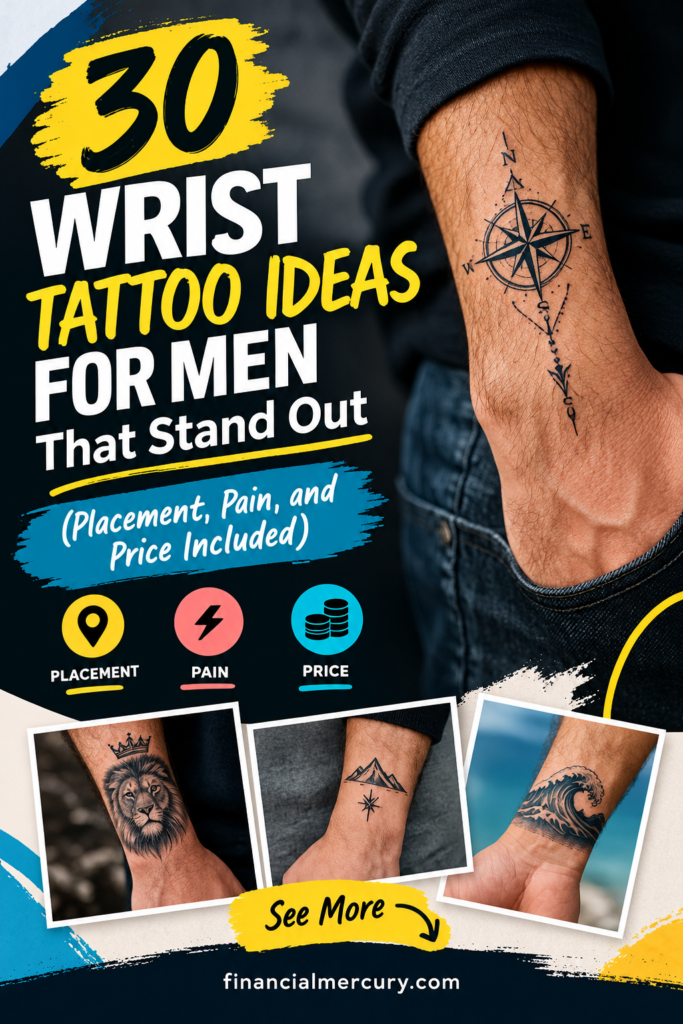
30 Wrist Tattoo Ideas for Men That Stand Out (Placement, Pain, and Price Included)
A wrist tattoo might be the smartest first tattoo a man can get. It’s visible when you want it seen and gone in seconds when you don’t: a watch, a sleeve, or a long-sleeve shirt covers it completely. That kind of flexibility matters whether you’re in a corporate job, on a job site, or somewhere in between.
The wrist also punches above its weight for design options. Small, simple symbols work well there, and so do detailed pieces that wrap around the arm like a bracelet. Everything sits close to the pulse, so even a tiny design gets noticed.
Below, you’ll find 30 wrist tattoo ideas for men that stand out, plus honest notes on placement, pain levels, and what each style typically costs. By the end, you’ll know which designs fit your style and how to approach your artist about them.
Why the Wrist Is One of the Best Tattoo Spots for Men
The wrist has stuck around as a favorite spot for men for good reasons. It’s one of the few placements that gives you full control over who sees your ink. Roll your sleeve down and it disappears. Wear a watch and nobody knows it’s there. Show it off at the gym or the beach and it gets noticed instantly. That balance is hard to find anywhere else on the body.
It also works for first tattoos. The designs that fit the wrist are usually small and simple, which keeps the cost and time commitment low. A clean 2-inch piece might take 30 to 45 minutes, so you’re not signing up for a marathon session on your first try.
Another plus: wrist tattoos pair well with everyday accessories. A minimalist bar, roman numerals, or a small symbol sits naturally next to a watch or a leather bracelet, almost like the pieces belong together. If you’re weighing your options across placements, our guide to tattoo placement for men breaks down how the wrist compares to spots like the forearm and chest.
Inner Wrist vs. Outer Wrist: Which Placement Fits Your Style?
The inner wrist is the personal spot. It faces you, not the world, so many guys choose it for designs with private meaning. The tradeoff is that the skin here is thin and sits close to the pulse point, which makes it a touch more sensitive and slightly trickier for artists to work on.
The outer wrist flips that equation. It’s more visible to others, the skin is a bit tougher, and artists generally find it easier to tattoo since the surface lies flat. If your design is meant to be seen, this is the side to pick.
There’s also a third option worth knowing: wraparound designs. These circle the whole wrist like a bracelet, using both sides. Bands, arrows, and script all work well in this format, and they look intentional from any angle.
How Much Do Wrist Tattoos Hurt?
Honest answer: the wrist hurts a moderate amount, more than your outer arm, less than your ribs or spine. Two things drive this. The skin is thin, and bone sits close to the surface, especially near the inner wrist where tendons cluster.
The good news is that most wrist pieces are small, so you’re only dealing with that sensation for a short window. Plenty of first-timers get through it fine. If you want to compare, the pain chart from Healthline ranks common tattoo spots so you can see where the wrist lands. Breathe steady, eat beforehand, and the session will be over before the discomfort peaks.
30 Prime Wrist Tattoo Ideas for Men That Stand Out
Here’s the full list, broken into three groups by style and intent. Each idea includes a quick note on the look, the meaning, and who it fits best. Use it as a shortlist to bring to your artist, then narrow it down together.
Bold and Masculine Wrist Tattoos
These designs favor heavy black ink, thick lines, and shapes that read clearly from a distance. They work especially well in blackwork and American traditional styles.
- Anchor. A classic nautical symbol of stability and staying grounded. It suits men with a connection to the water or anyone who values a steady path.
- Arrow. Clean, directional, and easy to stretch across the flat of the wrist. It stands for moving forward or being pulled toward a goal.
- Compass. Popular as a small round piece on the outer wrist. It signals a love of travel or a personal sense of direction.
- Tribal band. A wraparound design built from bold black patterns. It reads strong from every angle and honors Polynesian or cultural roots.
- Barbed wire. A tougher take on the band format. It gives off a gritty, rebellious edge without needing much detail.
- Dagger. Sharp lines make this a natural fit for the wrist. It often represents protection, sacrifice, or courage through hardship.
- Lion. A small lion head in heavy black shading projects strength and leadership. Choose a simplified design so it stays readable at this size.
- Skull. A minimalist skull works in fine line or solid black. It’s a memento mori, a reminder to live fully.
- Geometric shapes. Interlocking triangles, hexagons, or linework patterns suit the wrist’s flat surface. They look modern and age well.
- Spartan helmet. Instantly recognizable and packed with attitude. It fits men who identify with discipline and warrior grit.
Wrist Tattoos With Deep Personal Meaning
This group trades boldness for significance. Most are small, quiet designs that mean the most to the person wearing them, which makes the inner wrist a popular spot.
- Roman numerals. A wedding date, a birthday, a loss, all captured in elegant characters. They sit beautifully in a single line across the inner wrist.
- Coordinates. Latitude and longitude pin a location that changed your life. It’s subtle, and only you know the place.
- Dates. Written in your own choice of font, a date keeps a milestone close. Keep lettering small so it stays crisp over time.
- Script words. A single word like “breathe,” “strength,” or “family” in cursive. Pick a font that stays legible once the ink settles.
- Initials. The letters of a child, partner, or parent. Tiny and discreet, yet heavy with meaning.
- Cross. A simple faith statement that scales from minimal linework to detailed shading. It works on either side of the wrist.
- Feather. A symbol of freedom or a nod to Native American heritage. Fine line detail makes it feel light on the skin.
- Semicolon. Made famous by the suicide awareness movement, it marks continuation after struggle. Small, but it carries serious weight.
- Mountain range. A ridgeline across the wrist speaks to love of the outdoors or a challenge you climbed. Simple silhouettes hold up best.
- Waves. Three curved lines evoke the ocean, calm, or going with the flow. They also wrap nicely around the wrist.
Small and Minimalist Wrist Tattoos
Fine line work dominates here. These tattoos stay under an inch or two, hide easily under a watch, and cost the least.
- Single-line art. One unbroken line forms a face, animal, or abstract shape. It’s modern and looks great in delicate ink.
- Small birds. A swallow or flock in flight suggests freedom. Fine line keeps it airy.
- Lightning bolt. A quick burst of energy in a few strokes. It suits fast-paced, high-energy personalities.
- Crown. A tiny mark of self-respect or ambition. Simple enough to stay sharp for years.
- Music notes. For musicians and serious listeners alike. A short phrase of notes can even encode a favorite song.
- Chess piece. A knight or king for strategic thinkers. Bold silhouettes read better than detailed ones at this size.
- Soundwave. The waveform of a voice, a laugh, or a song. Personal and nearly invisible to strangers.
- Heartbeat line. An EKG pulse, often with a small heart or word inside it. It’s a favorite for memorials and survival stories.
- Moon phases. A row of lunar stages across the wrist. It connects to cycles, change, or a meaningful night sky.
- Dots and circles. Pure geometry at its smallest. A single dot or pair of circles makes a quiet, deliberate statement.
Whichever direction you lean, bring reference photos to your artist. Wrists are small canvases, so the best designs stay simple, and simplicity is what keeps them looking sharp a decade later.
How to Choose a Wrist Tattoo Design You Won’t Regret
The wrist lives a double life: private at work on Monday, on full display at the beach by Saturday. That flexibility is exactly why the decision deserves a slower pace, because ink you can hide is also ink you can stop thinking about. Two filters keep the choice honest: your real life, and the limits of a small canvas.
Match the Design to Your Lifestyle and Job
Start with an honest look at your week. Some offices still discourage visible ink, while kitchens, gyms, and trade sites rarely blink. Check your dress code, or better yet, notice how inked coworkers are treated before you book anything.
Then think about coverage in practice. A watch conceals the outer wrist in seconds and long sleeves handle the rest, but that plan only works if you actually wear one. If your job or climate keeps you in short sleeves, treat the design as permanently visible and choose accordingly.
Finally, favor timeless over trendy. Infinity signs, barcodes, and flash-in-the-pan fonts all date themselves, and the wrist sits at eye level during every handshake. Dates, initials, coordinates, and classic symbols keep their meaning because it never depended on fashion.
Three questions are worth answering before you commit:
- Can I cover this for an interview or formal event without effort?
- Will the design still describe me in ten years, or just this year?
- Do I like the tattoo itself, or only the reaction it might earn?
Picking the Right Size and Style for a Narrow Space
A wrist gives you roughly two inches of usable canvas, and it curves around tendons and bone the whole way. That shape punishes busy designs. Wrist skin also flexes and stretches more than the skin on your forearm, so ultra-fine lines can soften and spread within a few years.
Simple designs age better for that reason. An artist can scale a clean anchor, arrow, or bar down to wrist size and keep it sharp; a portrait with pore-level detail has nowhere to go. Lettering follows the same rule. Keep it small overall but not microscopic, since script finer than a pen stroke tends to feather first.
Wraparound bands work with the curve instead of against it. Because the circle itself carries the design, a band needs no fine detail to look finished, which is why arrows, waves, and simple linework dominate this format.
One last tip: bring reference photos to a consultation and ask the artist to size the piece for the spot, not the other way around. Their eye for what survives on a wrist is the best safeguard against regret.
Wrist Tattoo Costs, Aftercare, and Fading: What to Expect
A wrist tattoo costs less than most placements, and it heals faster than you might expect. The catch is that wrist skin works hard every day: it flexes, gets washed, and sees plenty of sun. That daily wear and tear makes aftercare the difference between ink that stays sharp for decades and ink that goes blurry within a couple of years.
What a Wrist Tattoo Usually Costs
Small tattoos are priced by the shop minimum, not by the inch. Most US shops set a minimum of $50 to $150 to cover setup, sterilization, and the artist’s baseline time. Because a typical wrist piece takes 30 to 45 minutes, your final bill usually lands between that minimum and one hour’s work.
Artists generally charge $100 to $200 per hour for anything bigger. The table below maps common wrist designs to realistic session times and costs.
| Design type | Session time | Typical cost |
|---|---|---|
| Tiny symbol (under an inch) | 15 to 30 minutes | $50 to $150 |
| Script, dates, or small icons | 30 to 60 minutes | $100 to $250 |
| Wraparound band or detailed piece | 1 to 2 hours | $150 to $400 |
Three factors move that number up or down. Artist reputation matters most, since a sought-after name in a big city can charge double what a small-town shop does. Detail level counts as well, because fine line script demands slower, steadier work than a bold silhouette. Color adds to the bill too, since packing solid color takes longer than a single black pass.
Budget for a tip on top of the quote. Fifteen to twenty percent is standard, so a $150 tattoo really costs closer to $175. Chasing the cheapest shop in town is a false economy; fixing bad work costs far more than good work costs up front.
Aftercare Tips to Keep Your Wrist Tattoo Sharp
Good aftercare follows the same basics anywhere on the body, but wrists come with quirks: they flex constantly, they rub against sleeves, and they sit right where watch straps live. Keep the routine simple for the first month.
- Wash gently with lukewarm water and fragrance-free soap two or three times a day, then pat dry with a clean paper towel.
- Moisturize with a thin layer of unscented lotion after each wash. A pea-sized amount is plenty; heavy layers trap bacteria and slow healing.
- Skip the watch, bracelets, and tight cuffs for at least two weeks so friction can’t pull color out of fresh skin.
- Keep the tattoo out of direct sun while it heals, then wear SPF 30 or higher on it from then on.
The surface usually heals in 2 to 4 weeks. Expect light itching and peeling around days four through seven as the skin repairs itself.
Peeling is the skin shedding on schedule. Picking steals ink with every flake you pull off, so leave it alone and let it fall when it’s ready.
Wrist ink fades a little faster than upper arm tattoos because the skin flexes all day and gets washed constantly. Fine line designs soften first. If lines blur or heal patchy, most artists include a free touch-up within the first year, so hang onto their contact info and check back once the tattoo has fully settled.
Conclusion
A wrist is a small canvas with big potential. Its two inches of skin reward simple, well-chosen designs, and the placement gives you control over who sees the ink and when. That combination is why the wrist keeps earning its spot among the best first-tattoo locations for men.
When narrowing down your shortlist, favor personal meaning over whatever is trending. A date, a coordinate, or a single bold symbol will still describe you in ten years; a fad design won’t. Just as important, choose an experienced artist. Wrist skin is thin, flexes constantly, and punishes shaky linework, so skill matters more here than on almost any other spot.
Save your favorite ideas from the list above, then book a consultation with a local shop and let a professional size the design to your wrist. Good ink starts with a good conversation.
Save pin for later

- 20 Small Shoulder Tattoo Ideas for High School Girls (Hidden, Cute, and Meaningful) - September 24, 2026
- 30 Wrist Tattoo Ideas for Men That Stand Out (Placement, Pain, and Price Included) - September 24, 2026
- 20 Pastel Tattoo Ideas for Men That Look Sharp, Plus Placement and Care Tips - September 24, 2026
Leave a Reply