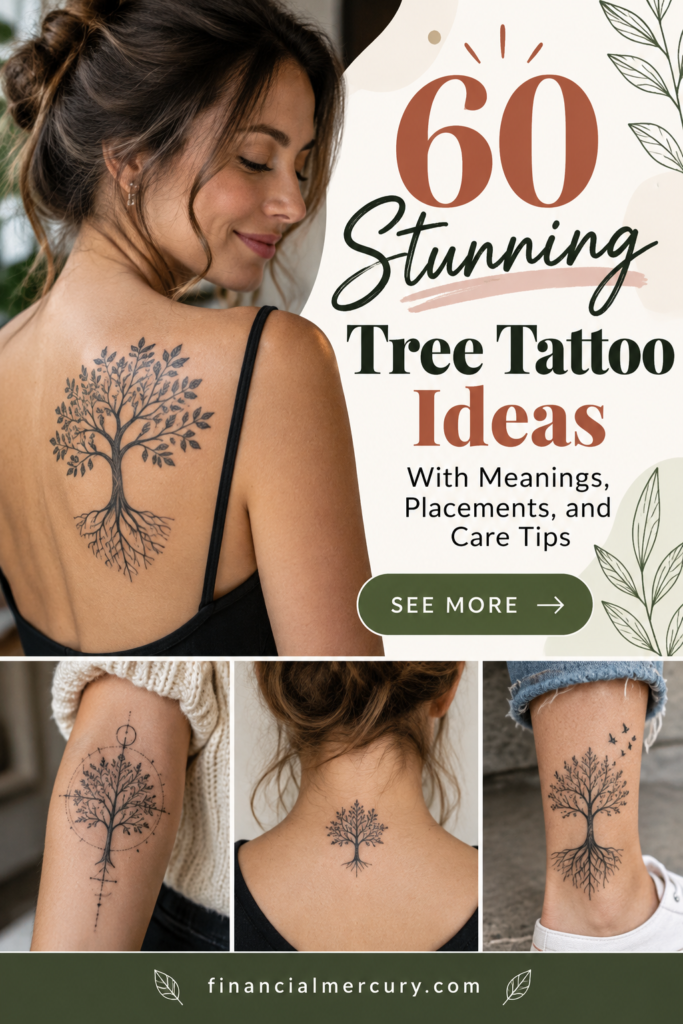
60 Stunning Tree Tattoo Ideas With Meanings, Placements, and Care Tips
A tree tattoo is one of those designs that never goes out of style. Roots, growth, strength, family ties: the symbolism runs deep, and it works whether you want something tiny behind your ear or a full sleeve.
The problem is finding the right one. There are thousands of options out there, and scrolling endlessly gets old fast. So we’ve pulled together 60 stunning tree tattoo ideas worth saving to your inspiration board, from minimalist willows to detailed oak pieces.
Below you’ll find designs with their meanings, style ideas (fine line, watercolor, traditional), placement and sizing suggestions, plus aftercare tips to keep your ink looking sharp for years. Keep scrolling and start building your shortlist.
What Tree Tattoos Really Mean
Trees carry meaning across almost every culture, and that’s a big reason they’ve stayed popular in tattoo studios for decades. A single design can stand for survival, ancestry, patience, or quiet strength depending on the tree you pick and the story you attach to it. Before choosing a design, it helps to know what each layer of symbolism actually says.
Growth, Strength, and New Beginnings
The most common meaning behind a tree tattoo is personal growth. A tree starts as a seed, pushes through seasons, and comes back after the harshest winter. That cycle hits home for anyone who has rebuilt their life after something hard.
People often get tree tattoos to mark a turning point. Someone finishing cancer treatment might choose a sapling to celebrate a fresh start. A person leaving a toxic relationship or getting sober might pick an oak, because oaks survive storms that level everything around them. The message is simple: I bent, but I didn’t break.
The details shift the meaning, too. A tree with new buds leans toward hope and rebirth, while a weathered, twisting trunk leans toward endurance. Even the roots matter. Visible roots say stability and grounding; a tree shown from above ground only says the story is still unfolding.
Family Roots and Heritage Symbolism
Roots run deep underground where nobody sees them, which is exactly why they’ve become a symbol for family history. The family tree tattoo is one of the most sentimental designs in the genre, and it has grown hugely in popularity over the last decade.
Some people add a name or birthdate to each branch to represent their children. Others keep the design abstract and let the spreading canopy stand for generations that came before them. Grandparents often inspire these pieces, honoring lineage in a way that feels permanent rather than framed on a wall.
Heritage plays a role here as well. A Celtic tree of life might nod to Irish ancestry, while a baobab can honor African roots. Whichever direction you go, the design says the same thing: I know where I come from, and it shaped who I am.
60 Stunning Tree Tattoo Ideas to Save
Now for the fun part: the designs themselves. We’ve grouped all 60 ideas by tree type and style so you can jump straight to what fits your story. Each idea includes a quick visual description and a note on who it suits best.
Tree of Life Tattoo Designs
The tree of life appears in Celtic, Norse, and spiritual traditions, which makes it one of the most versatile designs in this list.
- Classic circular tree of life: a tree enclosed in a perfect ring of branches and roots. Works for anyone who wants balanced, symmetrical meaning.
- Mandala tree of life: the canopy replaced with layered mandala petals. Suits people who love intricate, meditative detail.
- Watercolor tree of life: soft splashes of blue, green, or purple bleeding behind a black outline. A favorite for free spirits.
- Tree of life with birds: small birds flying from the branches. A quiet tribute to loved ones who have passed.
- Minimalist line version: one continuous line forming trunk and crown. Ideal for a first tattoo or a wrist spot.
- Half-and-half design: one side in full leaf, the other bare. Perfect if you want to represent loss and renewal together.
- Celtic knot trunk: interwoven knots filling the trunk. A strong pick for Irish or Scottish heritage.
- Moon-phase border: the circle replaced with lunar phases. Great for night-sky lovers.
- Sun and tree pairing: rays rising behind the canopy. Suits optimism and fresh starts.
- Geometric frame: the design set inside a sharp triangle or diamond. Good for modern, architectural taste.
Oak, Pine, and Willow Tree Tattoos
Different species tell different stories, so pick the tree that matches your own.
- Storm-battered oak: a thick, twisting trunk with deep roots, symbolizing strength that outlasts anything.
- Single acorn-to-oak pairing: acorn on one side, full oak on the other, showing growth over time.
- Oak with hanging swing: adds nostalgia and childhood memory to the classic strength symbol.
- Live oak with Spanish moss: a Southern-inspired take, beautiful in black and gray.
- Lone pine on a ridge: one pine against an empty sky. Suits independent, outdoorsy types.
- Pine line cluster: three slim pines in a row. Clean, simple, and works small.
- Pine with snow-capped peaks: mountain silhouettes behind the trees for a Pacific Northwest feel.
- Weeping willow in fine line: drooping branches drawn in delicate strokes, a classic memorial design.
- Willow over water: branches reaching toward a still lake, symbolizing reflection and grief processed over time.
- Willow with a name script: a loved one’s name tucked into the flowing branches.
- Autumn oak in watercolor: orange and red leaves falling from the canopy.
- Oak leaf only: a single detailed leaf for those who want subtle symbolism.
- Pinecone accent: small, detailed, and pairs well with other nature pieces.
- Bare willow in winter: stripped branches for a design about endurance through loss.
- Oak ring Tattoo: tree of life centered in a ring of oak leaves for family pieces.
Cherry Blossom and Sakura Tree Tattoos
In Japanese culture, sakura blooms last about a week, so these tattoos carry a meaning of impermanence: beauty that doesn’t last.
- Full arm sakura branch: blossoms wrapping shoulder to wrist in traditional Japanese style.
- Falling petals: a sparse branch with petals drifting down the forearm.
- Black and gray cherry blossom: monochrome shading for a softer, timeless look.
- Sakura with koi fish: a bold irezumi-inspired combination for larger pieces.
- Delicate wrist sprig: two or three blossoms. Perfect for a first tattoo.
- Cherry tree over a torii gate: a full Japanese scene for back or thigh placement.
- Sakura and crane pairing: blossom branches with a flying crane for luck.
- Negative space petals: skin left bare where petals would be.
- Watercolor sakura: pink washes fading into the branches.
- Sakura half sleeve: blossoms concentrated on the shoulder, fading toward the elbow.
Minimalist, Silhouette, and Small Tree Tattoos
If you want something low-key, this group delivers. These are all strong choices for a first tattoo because they hurt less, heal faster, and age well.
- Single-line tree: the entire design in one unbroken stroke.
- Tiny wrist evergreen: barely an inch tall, hidden or shown as you please.
- Forest silhouette band: a strip of black treetops circling the forearm or ankle.
- Negative space oak: the tree cut out of a solid black rectangle.
- Geometric triangle with a tree: a pine nested inside a sharp frame.
- Behind-the-ear sapling: small, meaningful, and easy to cover.
- Finger tree ring: a thin band of trees wrapping a finger.
- Heartbeat with a tree: an EKG line rising into a canopy.
- Stacked mountain and pine: two tiny shapes, big symbolism.
- Outline-only willow: fine linework that ages gracefully.
- Birch trunk pair: two slim white trunks with minimal detail.
- Constellation tree: branches dotted like stars.
- Ankle sapling in a circle: a miniature tree of life.
- Heart-shaped canopy: foliage forming a heart, popular for matching tattoos.
- Black triangle forest: layered peaks filling a triangle, very modern.
Forest, Roots, and Full Scene Tree Tattoos
Bigger ideas need bigger canvases. These designs shine as sleeves, back pieces, or thigh tattoos.
- Full forest sleeve: tall pines winding from wrist to elbow, dense with depth and shading.
- Roots-only design: an exposed root system inked across the chest or shoulder, a bold statement about heritage.
- Forest and moon: silhouetted trees under a full moon with soft shading.
- Foggy forest scene: layered trees fading into mist, stunning in black and gray realism.
- Trees with mountain range: a full landscape combining peaks and treeline.
- Wolves among the trees: forest silhouettes with animal eyes catching light.
- Upside-down forest reflection: a lake scene mirrored below the treeline.
- Roots into a name or dates: ancestral roots spelling out a family tribute.
- Aurora over the pines: northern lights in color above a black forest band.
- Back-piece redwoods: towering sequoias seen from below, made for a full back canvas.
Once you’ve shortlisted a few, show your artist reference images from more than one angle so they can adapt the design to your body and style.
Where to Put a Tree Tattoo: Placement and Size Guide
Placement makes or breaks a tree tattoo. A design that looks stunning on a forearm can turn to mush on a finger, and a huge forest scene crammed onto a wrist will blur within a few years. The trick is matching the size of your design to the space on your body, then checking how much pain that spot typically brings.
Best Spots for Small and Medium Tree Tattoos
Small designs (under three inches) work best on flat, low-movement areas. The inner wrist is the classic choice for a sapling or single-line tree, though the skin there is thin, so expect a sharp sting. The ankle and behind the ear suit tiny silhouettes too, and both hide easily under socks or hair.
Medium designs (three to six inches) have more room to breathe. The inner forearm is the most popular spot in most studios because it sits flat, faces you all day, and handles moderate detail well. The outer shoulder and upper arm offer similar space with noticeably less pain, since the muscle pads the area. Ribs can hold a taller design like a slim willow, but they rank high on the pain scale because the skin sits directly over bone and stretches with every breath.
One rule of thumb: the more detail in your design, the more size it needs. A fine line oak with 40 branches needs at least four inches, or the linework will merge as it ages.
Large Canvases: Sleeves, Back, and Chest
Full scenes, forests, and root systems need real estate. A full sleeve lets the tree flow with your arm: roots at the wrist, trunk along the forearm, branches spreading over the shoulder. That natural mapping is why tree sleeves look so good compared to other subjects.
The back is the largest canvas you have, ideal for towering redwoods or a sprawling forest with mountains. The chest works well for roots spreading from sternum to collarbone, a bold statement about heritage. Thighs are a strong middle option, big enough for a scene but easier to cover than a sleeve.
Pain-wise, forearms, calves, and outer thighs sit in the mild zone. Chest, ribs, spine, and the inner arm hurt more but reward you with the most striking placements. If it’s your first tattoo, start small somewhere forgiving, then build up to the big piece once you know how your body handles it.
How to Choose the Right Tree Tattoo Style for You
With 60 designs in front of you, the hardest part isn’t finding a tree you like. It’s narrowing the list down to the one you’ll be happy with in ten years. Style matters just as much as subject, because the same oak drawn in three different styles tells three different stories.
Matching the Style to Your Story
Start with meaning, then pick the aesthetic that carries it best. A realistic tree suits people who want raw, literal strength: detailed bark, visible roots, heavy shading. It works well for memorials because it feels grounded and true to life.
Fine line is the opposite approach. Thin, delicate strokes give you subtlety, and these designs age gracefully when kept small. If your story is quiet, like a sapling marking a fresh start, fine line fits.
Blackwork uses bold, solid black shapes and negative space. It reads as modern and confident, great for forest silhouettes and geometric frames. Watercolor adds soft color splashes behind the linework, which pairs beautifully with cherry blossoms and autumn oaks, though the color fades faster than black ink. Traditional style, with thick outlines and limited color, is the most durable option and suits classic symbols like the tree of life.
One practical note: intricate styles need size. A watercolor scene squeezed into two inches will blur long before a simple line version in the same spot.
Questions to Ask Your Tattoo Artist
Once you’ve picked a direction, the artist you choose decides how good the final piece looks. Before booking, cover the basics:
- Portfolio check: ask to see healed tree tattoos, not just fresh ones. Fresh ink always looks perfect; healed work shows how their lines actually settle.
- Custom versus flash: a custom design costs more but fits your body and story. Flash is cheaper and faster, but you share it with everyone else who walked in that week.
- Detail durability: ask directly whether the fine details in your design will hold at your chosen size. A good artist will tell you to simplify or scale up.
- Pricing: most artists charge hourly, often $100 to $200 depending on the shop and city. Get the estimate in writing.
Bring your saved references from the 60 ideas above. Showing three or four images you love tells the artist more in ten seconds than a paragraph of description ever could, and it keeps you both working from the same vision.
Tree Tattoo Aftercare and Making It Age Well
A tree tattoo lives or dies by its fine details. Thin branches, delicate roots, and soft shading only stay crisp if you treat the fresh ink properly and protect it for years afterward. Here’s how to handle both.
Healing Basics for the First Few Weeks
Your artist will cover the tattoo with a wrap or adhesive film like Saniderm. Leave it on for the time they recommend, usually 24 hours to several days. Once it comes off, wash gently with lukewarm water and fragrance-free soap, then pat dry with a clean paper towel. Never rub.
Moisturize with a thin layer of unscented lotion two or three times a day. Too much product suffocates the skin, so keep it light. Expect the tattoo to peel around day four or five, like a mild sunburn. Let the flakes fall on their own; picking them pulls ink out of those fine branch lines.
For the first two weeks, avoid swimming pools, baths, and direct sun. Showers are fine. By week three, the surface should look settled, though deeper layers keep healing for a month or more. Call your artist if you see spreading redness, warm skin, oozing, or streaks away from the design, since those can signal infection rather than normal healing.
Keeping Details Sharp Over the Years
Sun is the number one killer of tree tattoo detail. UV rays break down ink pigment, and thin lines suffer first. Once healed, apply SPF 30 or higher whenever the tattoo sees daylight. A broad-brim sunscreen stick makes this easy on forearms and ankles.
Design choice matters too. Hairline-thin branches drawn a millimeter apart will eventually merge as skin ages and ink spreads slightly under the surface. If you want a design that lasts decades, ask your artist for bolder linework or slightly larger spacing between elements. Black and gray ink holds longer than pale watercolor tones, which may need a refresh after five to eight years.
A touch-up every few years keeps shading even. Most artists charge a small fee or do minor touch-ups free within the first year. Treat the tattoo like a plant you actually care about: protect it from harsh sun, keep the skin moisturized, and your tree will grow old with you looking just as sharp as day one.
Conclusion
A tree tattoo is one of the most personal designs you can get. The species you pick, the style you choose, and the spot on your body all work together to tell your story, so take the time to match each one to what the tattoo means to you.
Go back through the 60 ideas above and save the ones that hit hardest. Then bring those references to your consultation, because showing your artist real images beats any written description. Whether you land on a tiny wrist sapling or a full forest sleeve, choose the design that feels like yours, and it’ll grow old with you looking just as sharp as the day you got it.
Save pin for later

- Hunting Gothic Skin: What the Search Term Can Mean - September 25, 2026
- Skull Tattoo Designs for Men That Stay Bold Over Time - September 25, 2026
- 30 Tips to Find Your Perfect Tattoo Style and Artist - September 25, 2026
Leave a Reply